
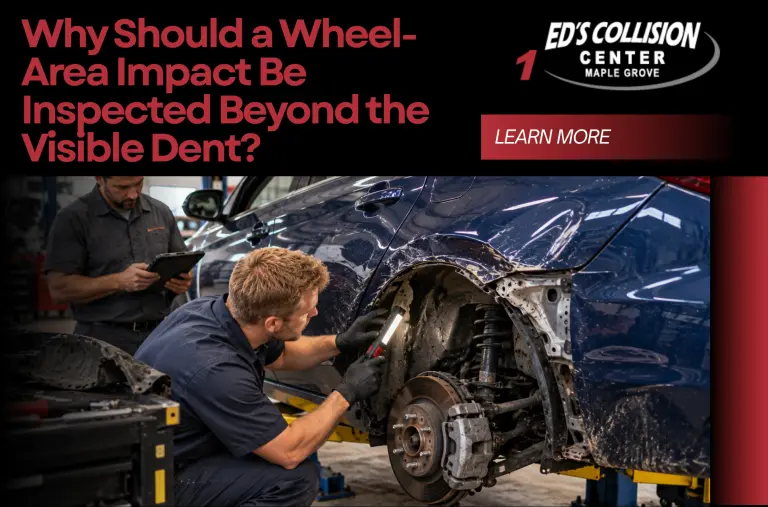
SUMMARY
- A collision near a wheel can affect more than the visible fender, quarter panel, or bedside dent because the wheel, tire, suspension, steering, alignment, wheelhouse, and nearby mounting areas may also be involved.
- A vehicle that still drives after the accident does not automatically confirm that every wheel-area component is undamaged.
- Warning signs can include pulling, vibration, an off-center steering wheel, unusual noises, tire damage, changed wheel position, or uneven gaps around the wheel opening.
- Wheel alignment can identify certain geometry concerns, but an alignment alone does not repair a bent or damaged suspension or steering component.
- Tire sidewalls and wheels should be inspected when they received direct collision contact, even when the damage initially appears cosmetic.
- Damage around the wheel opening can extend into the inner wheelhouse or nearby mounting areas, depending on the location and severity of the impact.
- Modern vehicles can also have wiring, sensors, and other electronic equipment near the corners of the vehicle.
- Technicians should identify damaged components before deciding whether the vehicle needs body repair, mechanical repairs, alignment, diagnostic scanning, calibration, or a combination of procedures.
- Hidden damage discovered during disassembly or measurement can result in an updated repair plan or insurance supplement.
- Maple Grove drivers can have wheel-area collision damage evaluated at Ed’s Collision 1, 10758 County Rd 81, Maple Grove, MN 55369.
Your Vehicle Has a Dent Near the Wheel. Why Inspect Anything Else?
Because the dent tells you where the collision happened, but not necessarily everything the collision affected.
Imagine another vehicle strikes your car around the front fender.
You can immediately see:
- Dented fender
- Scratched paint
- Damaged wheel-opening edge
The repair may appear to be straightforward auto body repair.
But directly behind and below that visible damage can be components connected to how the vehicle:
- Steers
- Handles
- Supports its weight
- Keeps the tire positioned
That is why a wheel-area collision deserves a broader inspection.
It does not mean every impact near a wheel causes suspension or structural damage.
It means technicians should determine whether the collision stopped at the exterior panel or continued into other components.
Step 1: Identify Exactly Where the Vehicle Was Hit
Start with the collision location.
Was the impact:
- Directly against the wheel?
- Above the wheel?
- In front of the wheel?
- Behind the wheel?
- Against the fender?
- Against the quarter panel?
- Against a pickup bedside?
The location helps technicians determine which nearby components deserve attention.
A shallow scrape along a fender presents a different situation from a collision where another vehicle directly contacts the wheel and pushes it sideways.
Why Does Direct Wheel Contact Matter?
The wheel connects to mechanical components that control its position and movement.
A force applied directly to the wheel can potentially transfer into:
- Suspension
- Steering components
- Wheel hub area
- Other mounting locations
The exact components vary by vehicle and whether the impact involves a front or rear wheel.
That is why technicians should inspect the specific vehicle instead of assuming every wheel-area collision causes the same damage.
Step 2: Inspect the Wheel
Start with what you can see.
Look for:
- Scratches
- Gouges
- Cracks
- Bent-looking areas
- Missing material
- Other new damage
Cosmetic scratching does not automatically mean the wheel is structurally damaged.
Likewise, a wheel that does not look dramatically damaged should not automatically be considered unaffected if it received a significant direct impact.
The collision history matters.
Can a Wheel Be Damaged Without Looking Obviously Bent?
Potentially.
Some damage is easier to recognize once the vehicle is raised or the wheel is inspected more closely.
If the wheel was directly struck, tell the repair facility.
Technicians can determine what inspection or measurement is appropriate.
Step 3: Inspect the Tire
The tire deserves attention whenever the collision occurs around the wheel.
Look for:
- Cuts
- Gouges
- Bulges
- Torn areas
- Sidewall damage
- Loss of pressure
A tire may absorb part of the collision force.
Damage to the sidewall is particularly important to identify because the sidewall is a critical part of the tire’s structure.
The National Highway Traffic Safety Administration provides consumer information about tire safety, maintenance, and tire-related warning signs.
What if the Tire Still Holds Air?
That is helpful information, but it does not prove that the tire is completely undamaged.
A tire can potentially remain inflated while still having visible collision-related damage.
If the tire was directly hit, have it inspected rather than relying only on whether it currently holds pressure.
Step 4: Look at the Wheel’s Position Inside the Opening
Stand back and compare the affected wheel with the wheel on the opposite side when possible.
Does the damaged-side wheel appear:
- Too far forward?
- Too far backward?
- Tilted differently?
- Positioned differently inside the wheel opening?
A visible change can indicate that something affecting wheel position deserves further inspection.
Do not try to diagnose the exact component yourself.
Simply point out the difference to the repair facility.
Does a Wheel That Looks Normal Mean the Suspension Is Fine?
Not necessarily.
Obvious wheel displacement is an important warning sign.
But the absence of obvious displacement does not confirm every suspension component is within specification.
Some changes may require:
- Inspection
- Measurements
- Alignment equipment
to identify.
Step 5: Inspect the Suspension
The suspension helps control wheel position and vehicle movement.
Depending on the vehicle, the area can include components such as:
- Control arms
- Struts or shocks
- Knuckles
- Links
- Other mounting components
The exact design differs among vehicles.
After direct wheel contact, technicians may inspect the appropriate suspension components for:
- Bending
- Cracking
- Movement
- Damaged mounting points
- Other collision-related changes
Can Suspension Damage Be Hidden?
Yes.
Some suspension components sit behind:
- Wheel
- Tire
- Fender
- Inner liner
That makes them difficult to evaluate from a normal standing position.
A technician may need to raise the vehicle and inspect the area from underneath.
Step 6: Consider Steering Components After a Front-Wheel Impact
If the collision involves a front wheel, steering components can also become relevant.
Tell the repair facility if the steering feels different afterward.
Possible symptoms include:
- Steering wheel no longer centered
- Vehicle pulling
- Different steering effort
- Unusual noise while turning
- Vehicle responding differently to steering input
These symptoms do not identify a specific damaged component by themselves.
They tell technicians where further diagnosis may be necessary.
Should You Keep Driving if the Steering Feels Different?
A significant change in steering after a collision should be taken seriously.
If the vehicle:
- Pulls strongly
- Has a visibly damaged tire
- Has a wheel sitting at an unusual angle
- Makes significant new noises
- Feels difficult to control
avoid assuming it is safe simply because it still moves.
Have the vehicle evaluated before continuing normal driving.
Step 7: Understand What Wheel Alignment Can Tell Technicians
Wheel alignment measures and adjusts specific wheel angles.
After a wheel-area impact, alignment information can help technicians identify whether the vehicle’s geometry is within specification.
But there is an important distinction:
Alignment adjusts geometry. It does not repair a physically bent component.
If a suspension or steering component is damaged, simply adjusting the alignment is not a substitute for repairing that damage.
Can an Alignment Fix Everything After a Wheel Impact?
No.
Suppose a collision bends a suspension component.
Attempting to adjust around the damaged component does not make the underlying physical damage disappear.
The appropriate sequence is generally to:
- Inspect the vehicle.
- Identify damaged components.
- Repair or replace components as required.
- Perform necessary measurements or alignment.
- Complete other required procedures.
The exact process depends on the vehicle and collision.
Step 8: Pay Attention to an Off-Center Steering Wheel
After the accident, driveability symptoms can provide useful clues.
One common concern is:
“My steering wheel used to be straight, but now it sits slightly turned while I’m driving straight.”
That change deserves inspection.
It can be related to wheel alignment or other collision-related conditions.
Do not assume the steering wheel itself is the problem.
The technician needs to determine why its position changed.
Step 9: Do Not Ignore New Vibration
A new vibration after a wheel-area impact should be reported.
You may notice it:
- Through the steering wheel
- Through the seat
- At certain speeds
- While braking
- During acceleration
Potential causes can vary widely.
The important information for the repair facility is:
- When the vibration started
- Where you feel it
- When it occurs
Avoid trying to diagnose it based only on the symptom.
Step 10: Listen for New Noises
Collision-related mechanical concerns can sometimes create new sounds.
Tell the repair facility if you notice:
- Clunking
- Rubbing
- Clicking
- Scraping
- Other unfamiliar sounds
A rubbing sound around the wheel could be as simple as a displaced liner contacting the tire.
Or it could involve something requiring additional inspection.
The sound needs to be traced to its actual source.
Step 11: Inspect the Fender or Quarter Panel
Now return to the visible body damage.
Front-wheel impacts often involve the:
- Fender
- Bumper
- Wheel-opening edge
Rear-wheel impacts can involve the:
- Quarter panel
- Rear door area
- Bumper
Pickup trucks may instead have damage around the:
- Bedside
- Wheelhouse
Technicians need to evaluate whether the visible panel can be repaired or needs replacement.
Does a Dented Fender Automatically Need Replacement?
No.
Repairability can depend on:
- Dent depth
- Creasing
- Material stretching
- Panel edges
- Cracking or tearing
- Mounting areas
- Material
- Manufacturer procedures
Some dents can be conventionally repaired.
Certain suitable dents with intact paint may also be candidates for paintless dent repair.
The repair method should match the actual damage.
Step 12: Inspect the Inner Wheelhouse
The exterior panel is not the only body component around the wheel.
Behind the visible opening can be:
- Inner wheelhouse
- Liners
- Brackets
- Mounting areas
- Other components
A stronger side impact can potentially push damage inward.
Technicians may need to remove liners or other components to see the complete area.
Why Does the Inner Wheelhouse Matter?
It helps form the area surrounding the wheel and provides attachment locations for nearby components.
Damage there may not be obvious from outside the vehicle.
If the exterior panel has been pushed significantly inward, inspecting what sits behind it helps establish how far the collision damage traveled.
Step 13: Check the Wheel-Opening Liner
Many vehicles use plastic liners inside the wheel opening.
A collision can:
- Crack the liner
- Tear attachment points
- Break clips
- Push it toward the tire
This can create rubbing noises.
A broken liner may look minor compared with the exterior body damage, but it should still be properly secured or repaired as appropriate.
Step 14: Look for Changed Panel Gaps
Wheel-area impacts can affect adjacent body panels.
For example, a front fender impact may change the gap between the:
- Fender and hood
- Fender and front door
- Fender and bumper
A rear-quarter impact can affect gaps around:
- Rear door
- Trunk
- Liftgate
- Bumper
New uneven gaps provide clues about how the exterior body components moved.
They do not automatically prove structural damage.
Step 15: Understand When Structural Measurement May Be Considered
Not every wheel-area collision requires structural measurement.
But stronger impacts may raise additional questions.
For example:
- Has a suspension mounting location moved?
- Are multiple panels suddenly misaligned?
- Is the wheel visibly displaced?
- Does the vehicle show significant underlying deformation?
Depending on the findings, technicians may use measurements and manufacturer specifications to evaluate the vehicle.
The I-CAR Repairability Technical Support Portal provides collision professionals with resources for researching OEM repair procedures and vehicle-specific repair considerations.
Does Wheel Damage Automatically Mean Frame Damage?
No.
A damaged:
- Wheel
- Tire
- Fender
- Suspension component
does not automatically mean the vehicle’s frame or body structure has been damaged.
Structural concerns need to be established through inspection and, when appropriate, measurement.
Avoid jumping from:
“My wheel was hit”
to:
“My frame must be bent.”
The actual damage determines the repair.
Step 16: Consider Sensors and Electronics Near the Collision
Modern vehicles can contain electronic equipment around their corners.
Depending on the vehicle, nearby equipment can include:
- Wheel-speed-related components
- Parking sensors
- Blind-spot monitoring equipment
- Wiring
- Other electronic systems
The exact location varies by make, model, and model year.
If the collision reaches areas containing these components or their mounting locations, technicians may need additional inspection or diagnostic procedures.
Can a Wheel-Area Collision Trigger Dashboard Warnings?
It can, depending on what was affected.
After an accident, watch for new warnings involving systems such as:
- ABS
- Stability control
- Traction control
- Tire pressure
- Driver-assistance systems
A warning light does not automatically tell you which component was damaged.
It provides information that technicians can use during diagnosis.
Step 17: Understand Diagnostic Scanning
Modern collision repair can involve diagnostic scanning.
A scan communicates with vehicle electronic modules and can help technicians identify stored diagnostic information.
It does not replace:
- Visual inspection
- Mechanical inspection
- Measurements
- Alignment
Likewise, a vehicle having no diagnostic trouble codes does not prove every mechanical component is undamaged.
Collision repair can require both:
physical inspection and electronic diagnosis.
Step 18: Understand When ADAS Calibration May Enter the Repair
Advanced Driver Assistance Systems can rely on:
- Cameras
- Radar
- Sensors
- Steering information
- Other vehicle inputs
The National Highway Traffic Safety Administration explains common driver-assistance technologies used on modern vehicles.
A wheel-area collision does not automatically mean ADAS calibration is required.
Whether calibration or another procedure is needed depends on:
- Vehicle
- Equipment
- Damaged components
- Repair operations
- Alignment work
- Manufacturer requirements
The technician should research the exact vehicle.
Step 19: Follow Vehicle-Specific Repair Procedures
A wheel-area impact on one vehicle may require a different repair process from the same-looking impact on another.
Manufacturers can specify procedures involving:
- Suspension components
- Structural areas
- Body panel repair
- Replacement
- Alignment
- Diagnostics
- Calibration
Collision Center 1 maintains multiple OEM certifications across its repair network.
The repair plan should consider the exact:
- Make
- Model
- Model year
- Equipment
- Collision damage
rather than relying on a universal wheel-impact repair checklist.
Step 20: Understand Why the Estimate May Change After Inspection
Imagine the initial estimate identifies:
- Dented fender
- Scratched wheel
- Damaged bumper
Once technicians gain better access, they might identify additional collision-related damage such as:
- Broken wheelhouse liner
- Damaged bracket
- Suspension concern
The repair plan can then be updated.
If insurance is involved, newly identified damage may be documented through a supplemental estimate.
Does an Insurance Supplement Mean the Original Estimate Was Bad?
Not necessarily.
Some damage cannot be fully confirmed during an exterior inspection.
A supplement allows the repair facility and insurer to address additional documented damage or repair operations discovered later.
Collision Center 1 offers insurance claim assistance to help customers navigate communication during the repair process.
The Minnesota Department of Commerce also provides consumer information about auto insurance claims.
Step 21: Tell the Repair Facility What Changed After the Accident
Your observations can help technicians.
Mention symptoms such as:
- “The steering wheel is crooked now.”
- “It pulls to the right.”
- “I hear rubbing when turning.”
- “There is a vibration at highway speed.”
- “The tire keeps losing pressure.”
- “A warning light came on after the accident.”
- “The wheel looks farther back than the other side.”
These details help the shop understand what changed after the impact.
You do not need to know why it changed.
Diagnosis is the technician’s job.
Step 22: Check More Than the Paint When You Pick Up the Vehicle
When the repair is complete, the bodywork should not be your only consideration.
Inspect the repaired area for:
- Panel alignment
- Wheel-opening shape
- Paint appearance
- Bumper fit
- Trim installation
Ask about any mechanical work performed.
If applicable, ask whether the repair included:
- Wheel or tire work
- Suspension repair
- Alignment
- Diagnostic scanning
- ADAS calibration
Keep the available documentation with your repair records.
Frequently Asked Questions
Can a wheel-area collision damage the suspension even if the vehicle still drives?
Potentially. The ability to drive does not confirm that every suspension or steering component is undamaged. Direct wheel contact, changed handling, unusual noises, or visible wheel-position changes are reasons for further inspection.
Does a wheel impact always mean the vehicle needs an alignment?
No. Whether alignment is appropriate depends on the collision and inspection findings. Technicians should also check for physical component damage rather than assuming alignment alone will correct the problem.
Can an alignment fix a bent suspension component?
No. Alignment adjusts specified wheel angles. A physically damaged suspension or steering component needs to be properly addressed rather than simply adjusted around.
Should the tire be inspected if it still holds air?
Yes, particularly if it received direct collision contact. Holding air does not by itself confirm that the tire has no impact-related damage.
Does an uneven wheel position mean the frame is bent?
Not automatically. Wheel position can be affected by several components. Inspection and, when appropriate, measurements are needed to identify the actual cause.
Can wheel-area damage affect electronic systems?
Potentially. Modern vehicles have wiring, wheel-related electronic components, and driver-assistance technology around various areas of the vehicle. The exact systems affected depend on the collision and vehicle.
Why can the repair estimate change after a wheel-area collision?
Additional damage can become apparent after the vehicle is raised, components are removed, measurements are taken, or mechanical systems are inspected. Those findings may require an updated repair plan.
Where can Maple Grove drivers have wheel-area collision damage inspected?
Drivers can visit Ed’s Collision 1 at 10758 County Rd 81, Maple Grove, MN 55369 for professional collision damage assessment and repair.
Look Beyond the Dent After a Wheel-Area Collision in Maple Grove
The visible dent may be the first thing you notice after an accident.
But when that dent is close to a wheel, it is worth asking one more question:
What else received the collision force?
Depending on the accident, technicians may need to evaluate the:
- Wheel
- Tire
- Suspension
- Steering
- Alignment
- Wheelhouse
- Body panels
- Mounting areas
- Electronics
That does not mean every wheel-area accident results in a complicated repair.
Sometimes the damage really is limited to the exterior panel.
The purpose of a complete inspection is to confirm that, rather than assume it.
Maple Grove drivers can learn more about auto body repair, collision repair, and OEM certifications, or visit the Maple Grove location for a professional collision damage evaluation.
Ed’s Collision 1
10758 County Rd 81 Maple Grove, MN 55369