
SUMMARY
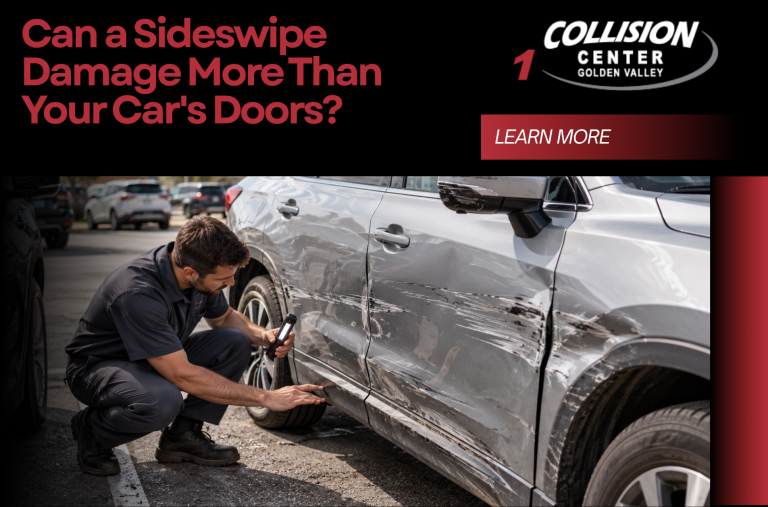
- Yes. A sideswipe can damage much more than the doors, even when door dents and scratches are the most obvious signs.
- Depending on where the vehicles made contact, damage can extend into the front fender, rear quarter panel, rocker panel, mirrors, wheels, tires, bumpers, and glass.
- A sideswipe near a wheel can potentially affect wheel alignment, steering, or suspension components, especially if the wheel or tire took a direct hit.
- Changes in door gaps or difficulty opening and closing a door may indicate damage involving hinges, latches, mounting areas, or nearby body structure.
- Modern doors and mirrors may contain wiring, cameras, sensors, window mechanisms, and other electronics that should be considered during the damage assessment.
- Paint scrapes can expose underlying material. Proper refinishing and corrosion protection may be necessary even when a damaged panel remains repairable.
- Some sideswipe damage is hidden behind exterior panels and trim, so the initial repair estimate can change after disassembly.
- Whether a panel should be repaired or replaced depends on the damage, material, location, and applicable OEM repair procedures.
- A vehicle that still drives normally can still have collision damage that deserves professional inspection.
- Golden Valley drivers can have sideswipe damage evaluated at Collision Center 1, 900 Florida Ave S, Golden Valley, MN 55426.
Your Doors Took the Hit. Is That the Only Damage You Need to Worry About?
Not necessarily.
Sideswipe accidents often leave obvious damage along the side of a vehicle.
You may immediately notice:
- Scratched doors
- Deep dents
- Paint transfer
- Damaged mirror
- Long creases
Because the damage appears concentrated along the doors, it is easy to assume:
“I just need the doors repaired.”
But a sideswipe can affect several connected areas.
Depending on the direction, height, and force of the impact, professional collision repair may involve inspecting much more than the damaged door skins.
The first step is determining where contact began, where it ended, and which components were caught in between.
Step 1: Follow the Damage From Front to Back
Do not inspect only the largest dent.
Look at the complete path of contact.
For example, a sideswipe might begin at the:
- Front bumper
continue across the:
- Fender
- Mirror
- Front door
- Rear door
and finish at the:
- Quarter panel
- Rear bumper
A long scrape provides useful information about how the vehicles interacted.
Look for:
- Scratches
- Dents
- Creases
- Paint transfer
- Cracked trim
- Changed panel gaps
Photograph the complete damaged side before repairs begin.
Why Does the Direction of the Sideswipe Matter?
The direction can help technicians understand how collision forces traveled across the vehicle.
An impact moving from front to rear may affect different:
- Panel edges
- Brackets
- Trim
- Mirrors
- Wheel areas
than an impact moving in the opposite direction.
Damage analysis should consider the entire contact area rather than treating each visible scratch as an unrelated problem.
Step 2: Inspect the Front Fender
If the sideswipe started near the front of the vehicle, check the fender.
Look for:
- Dents
- Sharp creases
- Scratches
- Bent wheel-opening edge
- Fender pushed toward the door
- Changed hood gap
A fender can sometimes be repaired.
Other damage may require replacement.
The decision depends on:
- Metal condition
- Panel material
- Damage location
- Mounting points
- Applicable repair procedures
Professional auto body repair should evaluate whether restoring the existing panel is appropriate before automatically choosing replacement.
Can a Bent Fender Affect the Door?
Yes.
The rear edge of the front fender sits close to the leading edge of the front door.
A sideswipe can push the fender backward.
You may then notice:
- Door rubbing against fender
- Door becoming harder to open
- Paint damage where panels contact
- Fender-to-door gap changing
Do not repeatedly force the door open if the panels are contacting each other.
That can create additional damage.
Step 3: Check Both Door Skins and Door Edges
A door’s outer surface may show the largest dent, but inspect the entire door.
Look at:
- Outer skin
- Front edge
- Rear edge
- Handle area
- Window frame
- Lower door
Damage around an edge can be particularly important because the panel contains tighter shapes and mounting relationships in those areas.
A deep crease does not automatically mean the entire door needs replacement.
Technicians need to evaluate whether the door can be appropriately restored.
When Can a Sideswiped Door Be Repaired?
Repair may be possible when:
- Metal remains suitable for reshaping
- Damage is accessible
- Door structure remains appropriate for repair
- Mounting areas are not severely damaged
- OEM procedures permit the repair
If the paint remains intact and the dent is suitable, paintless dent repair may sometimes be considered.
Conventional body repair may be appropriate when:
- Paint is damaged
- More metal correction is needed
- Refinishing is necessary
Replacement becomes more likely when damage is too severe for an appropriate repair.
Step 4: Check Whether the Doors Still Open and Close Normally
Carefully operate each affected door.
Ask:
- Does it open smoothly?
- Does it close without extra force?
- Does the latch engage normally?
- Does it sit flush with surrounding panels?
Watch for:
- Rubbing
- Binding
- Unusual movement
- Changed gaps
- New noises
These symptoms may indicate that the collision affected more than the exterior skin.
What Can Cause a Door to Stop Closing Correctly After a Sideswipe?
Possible causes include damage involving:
- Door itself
- Hinges
- Latch
- Striker
- Mounting points
- Adjacent panels
The exact cause needs to be inspected.
A door closing poorly does not automatically prove that the vehicle has major structural damage.
But it should not be dismissed as cosmetic either.
Step 5: Inspect the Side Mirror
Side mirrors are especially vulnerable during sideswipes.
Damage can include:
- Cracked housing
- Broken glass
- Loose mounting
- Scratches
- Internal electronic damage
Modern mirrors can contain much more than reflective glass.
Depending on the vehicle, a mirror may include:
- Heating
- Turn signal
- Camera
- Blind-spot indicator
- Power-folding mechanism
- Position controls
Check every function that was available before the collision.
Can a Mirror Still Work Even if It Was Damaged?
Yes.
A mirror may still:
- Adjust
- Fold
- Display an indicator
while its housing or mounting has been damaged.
Likewise, exterior damage may appear minor while an internal component has been affected.
Tell the estimator if any mirror function behaves differently after the accident.
Step 6: Check the Door Glass and Window Operation
Sideswipe damage can occur close to the window and window frame.
Inspect the glass for:
- Chips
- Cracks
- Scratches
- Misalignment
Operate the window carefully.
Listen for:
- Grinding
- Clicking
- Scraping
Watch whether the glass:
- Moves smoothly
- Tilts
- Binds
- Stops unexpectedly
If the glass is cracked or loose, avoid repeatedly operating it.
Collision Center 1 also provides auto glass repair when collision damage affects vehicle glass.
Why Can Window Problems Appear After Door Damage?
The door contains internal components that support and move the glass.
A strong impact can potentially affect:
- Window regulator
- Tracks
- Mounting points
- Wiring
The outer door may therefore be only one part of the repair.
Mention any change in window operation during the estimate.
Step 7: Inspect the Rocker Panel Below the Doors
Look underneath the damaged doors.
The long section below them is commonly called the rocker area.
A low sideswipe can potentially damage:
- Rocker panel
- Lower door edge
- Adjacent trim
Look for:
- Dents
- Scrapes
- Crushed areas
- Cracked coatings
- Exposed metal
Do not assume rocker damage is simply another cosmetic dent.
The construction and repair requirements can vary by vehicle.
Why Can Rocker Panel Damage Require Additional Attention?
The rocker area can be part of the vehicle’s body structure.
Depending on the vehicle, it may use:
- Multiple layers
- Reinforcements
- High-strength materials
Repair decisions should therefore consider the exact vehicle construction and applicable manufacturer information.
The I-CAR Repairability Technical Support Portal provides resources collision professionals can use when researching vehicle-specific repair procedures.
Step 8: Check the Rear Quarter Panel
If the sideswipe continued behind the rear door, inspect the quarter panel.
Look for:
- Dents
- Creases
- Scratches
- Wheel-opening damage
- Distortion around the rear bumper
Quarter panels can differ from doors and front fenders because they are commonly integrated into the vehicle body rather than simply bolted on.
That can make repair-versus-replacement decisions different.
Does Quarter Panel Damage Automatically Mean Replacement?
No.
Many quarter-panel dents can be repaired.
Technicians need to evaluate:
- Damage severity
- Metal stretching
- Panel material
- Damage location
- Access
- OEM procedures
A relatively large but smooth dent could potentially remain repairable.
A smaller area involving a critical edge or heavily stretched material could require a different approach.
Step 9: Look at the Wheels and Tires
This is one of the most important checks after a sideswipe.
Look at both wheels on the damaged side.
Inspect for:
- Tire cuts
- Sidewall damage
- Wheel scratches
- Bent rim
- Cracks
- Changed wheel position
A direct wheel impact can transfer force beyond the wheel itself.
It may affect:
- Steering
- Suspension
- Alignment
If the tire is visibly damaged, avoid unnecessary driving.
Can a Sideswipe Knock the Vehicle Out of Alignment?
Yes, particularly when a wheel or suspension component takes an impact.
Possible symptoms include:
- Vehicle pulling
- Steering wheel no longer centered
- Uneven steering feel
However, do not assume every post-collision steering concern can be fixed with an alignment.
Technicians should first determine whether any physical components were damaged.
An alignment cannot repair a bent wheel, steering component, or suspension part.
Step 10: Pay Attention to New Vibration or Noise
If the vehicle remains safe to move, pay attention to how it behaves.
Listen for:
- Rubbing
- Scraping
- Rattling
- Grinding
- Wind noise
Watch for:
- Vibration
- Pulling
- Steering changes
These symptoms can help identify areas that deserve additional inspection.
For example, rubbing could come from:
- Damaged wheel liner
- Body panel touching tire
- Loose trim
Wind noise might involve:
- Door alignment
- Window alignment
- Weatherstripping
- Mirror mounting
Do not assume every new symptom has the same cause.
Step 11: Check the Rear and Front Bumpers
Depending on the length of the sideswipe, one or both bumpers may be involved.
Inspect the corners for:
- Scratches
- Cracks
- Separation
- Loose mounting
- Changed gaps
A bumper cover can sometimes flex during an impact.
The exterior may therefore show less damage than components underneath.
Depending on the vehicle, the area behind the bumper can include:
- Reinforcement
- Absorber
- Brackets
- Wiring
- Sensors
Additional damage may become visible after disassembly.
Step 12: Check for Dashboard Warnings
After the collision, look at the instrument panel.
Watch for new warnings involving:
- Airbags
- ABS
- Driver-assistance systems
- Blind-spot systems
- Parking assistance
- Other electronics
Photograph any warning message.
Even if the warning later disappears, the photo gives the repair facility useful information.
No warning lights?
That is encouraging.
But it does not prove that every physical component is undamaged.
Step 13: Consider Driver-Assistance Sensors
Modern vehicles may contain Advanced Driver Assistance Systems, or ADAS, around areas affected by a sideswipe.
Depending on the vehicle, components can be located around:
- Side mirrors
- Front bumper
- Rear bumper
- Windshield
- Body corners
The National Highway Traffic Safety Administration explains how driver-assistance technologies can support functions including blind-spot warning, automatic emergency braking, lane assistance, and other features.
If the collision affected a sensor or its mounting area, additional inspection may be necessary.
Does Every Sideswipe Require ADAS Calibration?
No.
Calibration requirements depend on:
- Vehicle
- Installed equipment
- Damage location
- Components removed
- Components replaced
- OEM procedures
A scratched door on one vehicle may have no calibration requirement.
A sideswipe involving a sensor-equipped mirror or another ADAS-related component may require additional procedures.
The repair facility should research the specific vehicle rather than assuming every sideswipe is the same.
Step 14: Look for Changes in Panel Gaps
Compare the damaged side with the undamaged side when possible.
Look at gaps around:
- Doors
- Fender
- Hood
- Quarter panel
- Bumpers
Watch for areas that appear:
- Wider
- Narrower
- Uneven
Changed gaps can result from:
- Bent exterior panel
- Damaged mounting point
- Hinge movement
- Underlying body movement
Panel gaps provide clues.
They do not, by themselves, prove structural damage.
Step 15: Understand Why Hidden Damage Can Appear During Repair
Some damage cannot be seen until exterior components are removed.
Imagine a sideswipe that visibly damages:
- Front door
- Rear door
After disassembly, technicians may also find:
- Broken trim mounting
- Damaged wiring
- Inner-door damage
- Additional mounting damage
The initial estimate may therefore change.
The repair facility can document newly discovered accident-related damage through a supplemental estimate.
This does not automatically mean the original estimate was wrong.
The additional damage may simply have been hidden.
Step 16: Ask About OEM Repair Procedures
OEM means Original Equipment Manufacturer.
Vehicle manufacturers publish repair information that can affect how collision-damaged components should be handled.
Depending on the vehicle and repair, procedures can address:
- Repair versus replacement
- Structural materials
- Joining methods
- Corrosion protection
- Scanning
- Calibration
Collision Center 1 maintains multiple OEM certifications across its repair network.
A door, rocker, or quarter-panel repair appropriate for one vehicle should not automatically be assumed appropriate for another.
Why Do Vehicle Materials Matter After a Sideswipe?
Modern vehicles can use different materials and strengths in different areas.
These can include:
- Conventional steel
- High-strength steel
- Ultra-high-strength steel
- Aluminum
- Composite materials
Different materials may require different:
- Tools
- Techniques
- Repair limitations
- Joining procedures
That is why technicians should identify the damaged material before choosing the repair method.
Step 17: Check for Scratches That Expose Bare Metal
Some sideswipes leave long scratches rather than major dents.
Do not ignore deep scratches.
Look for:
- Exposed primer
- Bare metal
- Chipped edges
Exterior coatings help protect underlying materials.
When collision damage breaks through those coatings, the repair may need to restore:
- Surface finish
- Corrosion protection
Professional refinishing is about more than making the vehicle look better.
It also restores protection to areas disturbed during the repair.
Can Paint Transfer Be Removed Without Repainting the Panel?
Sometimes.
What looks like a severe scratch may partly consist of paint transferred from the other vehicle.
But do not assume every mark can simply be polished away.
Underneath the transferred material, your vehicle may have:
- Clear-coat damage
- Paint damage
- Dent
- Exposed substrate
A professional assessment can determine how deep the damage actually goes.
Step 18: Get a Complete Sideswipe Damage Assessment
When bringing the vehicle for an estimate, explain:
- How the collision happened
- Which direction the other vehicle traveled
- Where contact started
- Where contact ended
- Whether a wheel was struck
- Whether steering changed
- Whether doors operate differently
- Whether warning lights appeared
Those details can help the estimator understand the collision path.
Golden Valley drivers can begin through the Collision Center 1 Golden Valley location.
What Should You Ask During a Sideswipe Repair Estimate?
Useful questions include:
- Is the damage limited to the exterior panels?
- Can the doors be repaired?
- Is the rocker panel damaged?
- Did either wheel take an impact?
- Should the suspension or steering be inspected?
- Are any electronics damaged inside the doors or mirrors?
- Are ADAS components involved?
- Is structural measurement needed?
- What do the OEM procedures require?
- Could additional damage appear after disassembly?
A good estimate should explain the repair rather than simply provide a total price.
Step 19: Understand How Insurance Fits Into the Repair
If you plan to file an insurance claim, document the damage before repairs begin.
Keep:
- Accident photos
- Claim information
- Initial estimate
- Supplements
- Final repair paperwork
Collision Center 1 provides insurance claim assistance to help customers navigate communication during collision repairs.
The Minnesota Department of Commerce also provides consumer information about auto insurance and claims.
If additional damage is found after disassembly, the repair facility may communicate those findings to the insurer through a supplement.
What if the Insurance Estimate Only Includes Door Damage?
Ask the repair facility whether it found anything else during its damage assessment.
If additional collision-related damage is discovered, the shop can document it.
For example:
Insurance estimate:
- Front door repair
- Rear door repair
After professional inspection or disassembly:
- Damaged mirror mounting
- Rocker damage
- Broken trim
- Additional wheel-related concern
The repair plan can then be updated based on the actual damage.
Can a Sideswipe Be Mostly Cosmetic?
Yes.
Some low-speed sideswipes primarily cause:
- Scratches
- Paint transfer
- Shallow dents
But the appearance alone should not be used to assume every sideswipe is cosmetic.
Pay particular attention when the collision involved:
- Wheel
- Rocker panel
- Mirror
- Door operation
- Significant panel movement
Those areas can justify additional inspection.
Can You Drive After a Sideswipe?
Sometimes.
Before continuing to drive, check for obvious problems involving:
- Tires
- Wheels
- Loose panels
- Mirrors
- Doors
- Glass
- Exterior lighting
Avoid unnecessary driving if you notice:
- Tire damage
- Wheel damage
- Bodywork rubbing the tire
- Steering changes
- Significant vibration
- Door that will not latch
- Loose components
- Serious warning messages
When uncertain, professional assistance is safer than assuming the vehicle is fine because it still moves.
What Should You Check After Sideswipe Repairs Are Complete?
Before leaving the repair facility, inspect the repaired side.
Look at:
- Panel alignment
- Paint appearance
- Panel gaps
- Door edges
- Mirror
- Wheel opening
Operate:
- Doors
- Windows
- Locks
- Mirror controls
If the collision involved the wheels, steering, or ADAS equipment, ask what related procedures were performed and what documentation is available.
Keep your final repair records.
Frequently Asked Questions
Can a sideswipe damage more than the doors?
Yes. Depending on the collision path, damage can extend into the fenders, mirrors, rocker panels, quarter panels, bumpers, wheels, tires, glass, and components underneath exterior panels.
Can a sideswipe damage the suspension?
Yes, particularly when a wheel or tire receives a direct impact. Pulling, vibration, unusual wheel position, or steering changes should be professionally evaluated.
Can sideswipe door damage be repaired without replacing the doors?
Sometimes. Repairability depends on the metal condition, damage location, panel material, inner-door condition, mounting areas, and applicable OEM repair procedures.
Can a sideswipe damage the rocker panel?
Yes. A low side impact can damage the rocker area beneath the doors. Because vehicle construction varies, the appropriate repair should be determined using the actual damage and manufacturer information.
Can a damaged side mirror affect safety technology?
Potentially. Some modern mirrors contain cameras, blind-spot indicators, and other electronics. The equipment installed on the specific vehicle should be checked after an impact.
Does every sideswipe require an alignment?
No. Alignment needs depend on the impact. If a wheel was struck or steering changed, technicians should inspect for physical damage before determining whether alignment is appropriate.
Does every sideswipe require ADAS calibration?
No. Calibration depends on the vehicle, installed technology, damaged components, repair operations, and applicable OEM procedures.
Where can Golden Valley drivers have sideswipe damage inspected?
Golden Valley drivers can visit Collision Center 1 at 900 Florida Ave S, Golden Valley, MN 55426 for professional auto body and collision damage assessment.
Have the Entire Damaged Side Inspected After a Sideswipe in Golden Valley
A sideswipe can leave obvious damage across one or more doors.
But stopping the inspection at the doors can miss other affected areas.
Depending on the collision, technicians may also need to evaluate the:
- Fender
- Mirror
- Glass
- Rocker panel
- Quarter panel
- Bumpers
- Wheels
- Tires
- Steering and suspension
- Electronic systems
The goal is to understand the complete path of the collision, not simply repair the largest visible dent.
Some sideswipes are primarily cosmetic.
Others can involve hidden components or areas that affect how the vehicle operates.
A professional damage assessment can determine which situation applies to your vehicle and whether individual panels should be repaired or replaced according to the applicable manufacturer procedures.
Golden Valley drivers can learn more about Collision Center 1’s auto body repair, collision repair, and OEM certifications, or visit the Golden Valley location to have sideswipe damage evaluated.
Collision Center 1 – Golden Valley
900 Florida Ave S Golden Valley, MN 55426