
SUMMARY
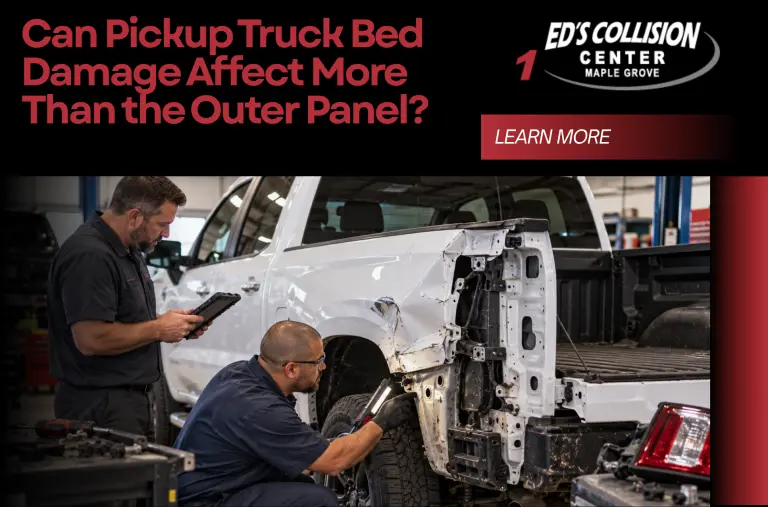
- Yes. Pickup truck bed damage can extend beyond the visible outer bedside panel and affect inner structures, wheelhouse areas, mounting points, tailgate components, lamps, wiring, and nearby suspension or wheel components.
- A dented bedside does not automatically mean hidden structural damage exists, but the complete damaged area should be inspected before deciding how the truck should be repaired.
- The outer bedside and inner portions of the bed work together as an assembly, so a harder impact can transfer force beyond the first visible dent.
- Damage near the rear wheel deserves additional attention because the collision may also involve the wheel, tire, suspension, or wheelhouse.
- Rear-corner impacts can affect the tailgate opening, rear bumper, taillight mounting area, and panel gaps, even when the main dent appears to be on the bedside.
- Bedside repair versus replacement depends on the truck’s construction, material, damage location, severity, accessibility, and manufacturer repair procedures.
- Modern pickups can contain parking sensors, blind-spot monitoring components, cameras, wiring, and lighting equipment around the bed and rear bumper.
- Disassembly may reveal damage that was hidden during the initial estimate, which can result in a supplemental repair plan.
- The repair process should consider the exact truck make, model, model year, and manufacturer procedures rather than assuming every pickup bed is built or repaired the same way.
- Maple Grove truck owners can have collision damage evaluated at Ed’s Collision 1, 10758 County Rd 81, Maple Grove, MN 55369.
Your Truck Has a Dented Bedside. Is the Damage Really Limited to That Panel?
Sometimes it is.
Sometimes it is not.
A pickup can leave an accident with one obvious problem:
A large dent in the side of the bed.
From the outside, it may look like a straightforward body repair.
But a pickup bed contains more than the exterior panel you can see.
Depending on the truck and location of the impact, technicians may also need to inspect:
- Inner bed components
- Wheelhouse
- Bed floor
- Mounting areas
- Taillight area
- Tailgate opening
- Rear bumper
- Wiring
- Electronic equipment
- Wheel and suspension
That does not mean all of these components are damaged.
It means professional collision repair should determine how far the collision force traveled before the repair plan is finalized.
Step 1: Start With the Location of the Impact
Where the truck was hit can tell technicians where to begin looking.
A bedside impact can occur:
- In front of the rear wheel
- Directly above the wheel
- Behind the rear wheel
- Near the taillight
- At the rear corner
- Near the tailgate opening
Each location can involve different nearby components.
For example, an impact directly above the wheel deserves a different inspection than a shallow dent high on the bedside.
Why Does Impact Location Matter So Much?
Collision forces do not always stop at the visible dent.
The force can travel into:
- Adjacent panels
- Attachment points
- Brackets
- Inner components
The direction and severity of the impact influence what should be inspected.
Technicians therefore look at the complete damage pattern rather than evaluating the dent by itself.
Step 2: Understand the Difference Between the Bedside and the Complete Truck Bed
The bedside is the exterior side panel of the pickup bed.
But the complete bed can include:
- Outer bedside
- Inner bedside
- Bed floor
- Wheelhouse
- Front bed panel
- Rear areas around the tailgate
- Supporting and mounting components
Construction varies among manufacturers and truck models.
That is why the repair facility needs to identify exactly which components are damaged before determining whether the repair involves only the exterior panel.
Can the Outer Bedside Be Damaged While Everything Behind It Is Fine?
Yes.
A relatively minor impact may affect only the exterior portion.
The presence of a dent does not automatically mean the inner bed structure has moved.
However, technicians should inspect deeper when the damage includes signs such as:
- Severe creasing
- Torn metal
- Distortion near mounting areas
- Changed tailgate gaps
- Wheel impact
- Significant rear-corner deformation
The goal is to confirm the extent of the damage instead of assuming either a minor or major repair.
Step 3: Inspect the Inside of the Bed
Looking inside the truck bed can provide additional clues.
Check for changes such as:
- New ripples
- Buckling
- Cracks
- Separation
- Distortion
Pay attention to the area opposite the exterior impact.
A dent visible outside may have pushed into an inner component.
The technician can compare the damaged area with the opposite side when appropriate.
What if the Bed Floor Looks Normal?
That is a positive sign, but it does not automatically confirm that every component is undamaged.
Some collision damage can occur:
- Behind exterior panels
- Around mounting areas
- Inside wheelhouse areas
- Near brackets
A complete assessment considers both visible condition and areas hidden from normal view.
Step 4: Inspect the Wheelhouse
The wheelhouse surrounds part of the rear wheel area.
A bedside collision close to the wheel opening can potentially affect this area.
Technicians may inspect for:
- Distortion
- Cracks
- Separation
- Changed attachment points
- Contact with surrounding components
Damage near the wheel opening can be especially important because several body and mechanical components are located close together.
Why Does Damage Above the Rear Wheel Need More Attention?
The visible dent may be only one part of the impact.
The collision could potentially involve:
- Bedside
- Wheelhouse
- Wheel
- Tire
- Suspension
That does not mean all five are necessarily damaged.
But if the impact occurred near the wheel, the repair facility should consider the mechanical components as part of the inspection.
Step 5: Check the Rear Wheel and Tire
If another vehicle or object contacted the wheel area, tell the repair facility.
Look for:
- Wheel scratches
- Bent-looking rim
- Tire damage
- New vibration
- Pulling
- Unusual noises
A truck that still drives normally can still benefit from an inspection when the wheel took a direct collision force.
The visible bedside repair should not distract from checking nearby mechanical components.
Can the Suspension Be Damaged Without an Obvious Broken Part?
Potentially.
Collision-related suspension damage is not always easy to identify from a quick exterior look.
Changes can sometimes appear as:
- Different wheel position
- Steering changes
- Vibration
- Tire wear
- Alignment concerns
Technicians can inspect the relevant components and determine whether measurements or alignment checks are appropriate.
Step 6: Inspect the Tailgate Opening
A rear-quarter or rear-corner impact can potentially change the shape of the tailgate opening.
Try to notice whether the tailgate:
- Opens normally
- Closes normally
- Latches correctly
- Has even gaps
- Sits flush when closed
A tailgate that suddenly behaves differently after the accident provides useful information about the collision.
Do not repeatedly slam a tailgate that no longer closes correctly.
Have the surrounding area inspected.
Does a Changed Tailgate Gap Mean the Truck Bed Is Structurally Damaged?
Not automatically.
A changed gap could result from:
- Damaged tailgate
- Bent bedside
- Damaged hinge
- Latch movement
- Rear panel distortion
- Other mounting damage
The gap tells technicians that something changed.
Further inspection determines what actually moved.
Step 7: Inspect the Tailgate Itself
Modern pickup tailgates can be more complex than a simple sheet-metal panel.
Depending on the truck, a tailgate may contain:
- Handle
- Latches
- Cables
- Wiring
- Camera
- Electronic lock
- Other convenience features
Collision damage around the rear corner or tailgate should therefore be evaluated for both:
- Physical operation
- Electronic operation
A tailgate that looks fine externally may still need inspection if it stopped functioning normally after the collision.
Step 8: Inspect the Taillight Area
Pickup taillights are commonly located at the rear corners of the bed.
That places them close to many common bedside impacts.
Technicians should inspect:
- Lens
- Housing
- Mounting tabs
- Brackets
- Wiring
- Connectors
A taillight can still illuminate even if its mounting system has been damaged.
Just like a headlight, electrical operation does not automatically confirm that the complete assembly is physically undamaged.
What if the Taillight Is Pushed In but Still Works?
The mounting area may have moved.
Possible causes include:
- Damaged lamp bracket
- Broken mounting tab
- Distorted bedside
- Damaged inner mounting area
The technician should identify why the lamp changed position rather than simply repositioning it without addressing the cause.
Step 9: Inspect the Rear Bumper
A bedside collision near the back of the truck can also involve the bumper.
Visible bumper damage may include:
- Scratches
- Dents
- Cracks
- Misalignment
There can also be damage behind the visible bumper surface.
Depending on the truck, technicians may need to inspect:
- Brackets
- Mounting areas
- Wiring
- Electronic components
The bumper and bedside should be evaluated together when the collision involves the rear corner.
Step 10: Consider Parking Sensors and Other Electronics
Many modern pickup trucks have electronic equipment around the rear bumper and bed.
Depending on the vehicle, this can include:
- Parking sensors
- Rear camera
- Blind-spot monitoring equipment
- Trailer-related electronics
- Lighting
- Wiring
The National Highway Traffic Safety Administration provides information about driver-assistance technologies commonly found on modern vehicles.
The exact equipment varies significantly among pickups.
Technicians should identify what the specific truck has before deciding whether any electronic systems require additional inspection.
Can a Bedside Collision Affect Blind-Spot Monitoring?
Potentially, depending on the vehicle.
Some vehicles use radar or other sensors located toward the rear corners.
A collision involving:
- Rear bedside
- Rear corner
- Bumper
may therefore be close to driver-assistance equipment.
That does not automatically mean the system was damaged or needs calibration.
The repair facility should determine:
- Where the equipment is located
- Whether the collision affected it
- Whether mounting points were disturbed
- What the manufacturer specifies after the repair
Step 11: Understand the Difference Between Scanning and Calibration
Modern truck repairs may involve electronic procedures.
Two terms customers often hear are:
Scanning
and
calibration.
They are not interchangeable.
Diagnostic Scanning
A diagnostic scan communicates with electronic modules and can help identify stored diagnostic information or trouble codes.
Calibration
Calibration is a separate procedure used when specified for certain cameras, radar units, sensors, or related systems.
Depending on the truck and repair, technicians may determine that the vehicle needs:
- Scanning
- Calibration
- Both
- Neither
The applicable manufacturer procedure should guide that decision.
Step 12: Check the Bed’s Mounting Areas
Pickup beds are attached to the truck through specific mounting locations.
A harder collision may require technicians to consider whether these areas were affected.
Possible clues include:
- Bed sitting differently relative to cab
- Unusual gap between bed and cab
- Bed shifted sideways
- Significant distortion through multiple areas
These symptoms do not automatically prove that the bed mounts are damaged.
They indicate that further evaluation may be appropriate.
What Should the Gap Between the Cab and Bed Look Like?
Pickup trucks normally have a visible separation between the cab and bed.
After an accident, technicians can look for:
- Uneven spacing
- Different alignment from side to side
- Evidence that the bed shifted
Comparing the damaged and undamaged sides can provide useful clues.
Vehicle measurements and manufacturer specifications may be needed when significant movement is suspected.
Step 13: Understand Why Frame Inspection Can Sometimes Be Relevant
Most pickup trucks use body-on-frame construction, although vehicle construction should always be confirmed for the specific truck.
The bed is mounted above the frame.
A dented bedside does not automatically mean the frame is damaged.
However, a significant collision can require technicians to inspect beyond the bed itself.
Possible reasons for additional evaluation include:
- Strong rear impact
- Wheel displacement
- Bed visibly shifted
- Multiple alignment changes
- Damage around bed mounting locations
The repair facility can determine whether measurements are appropriate.
Does Every Damaged Pickup Bed Require Frame Measuring?
No.
A small bedside dent and a severe rear collision are very different repair situations.
The inspection should match:
- Impact severity
- Damage pattern
- Vehicle construction
- Technician findings
The goal is not to perform unnecessary procedures.
It is to avoid overlooking relevant collision damage.
Step 14: Determine Whether the Bedside Can Be Repaired
Not every dented bedside needs replacement.
Technicians may evaluate:
- Dent depth
- Creasing
- Metal stretching
- Tears
- Panel edges
- Body lines
- Wheel opening
- Mounting areas
- Accessibility
Some damage may be suitable for conventional auto body repair.
The decision should be based on the actual condition of the component and manufacturer procedures.
Could Paintless Dent Repair Work on a Truck Bed?
Sometimes.
Paintless dent repair may be an option when:
- Paint remains intact
- Dent shape is suitable
- Metal condition supports PDR
- Technician can appropriately access the damage
It may not be suitable for damage involving:
- Torn metal
- Cracked paint
- Severe creases
- Significant stretching
- Heavily damaged panel edges
The repair method should fit the damage.
Step 15: Understand Why Truck Material Matters
Pickup manufacturers use different materials and construction methods.
Depending on the truck, the damaged area may involve:
- Steel
- High-strength steel
- Aluminum
- Other materials or combinations
The material can affect:
- Repairability
- Tools
- Joining procedures
- Replacement procedures
- Corrosion protection
Technicians should identify the specific vehicle and component before selecting a repair method.
Why Can’t Every Truck Bedside Be Repaired the Same Way?
Because trucks are not constructed identically.
A repair procedure that applies to one:
- Make
- Model
- Model year
may not apply to another.
Manufacturer information can specify:
- Whether a component can be repaired
- Where replacement joints are allowed
- What joining methods are required
- What protective materials must be restored
The I-CAR Repairability Technical Support Portal provides collision professionals with resources for researching OEM repair procedures and repairability questions.
Step 16: Understand Bedside Replacement
If damage is not suitable for repair, the repair plan may call for replacement.
Bedside replacement can be more involved than simply removing a visible outer panel and installing another one.
Depending on the truck, technicians may need to consider:
- Attachment locations
- Joining methods
- Adjacent components
- Corrosion protection
- Refinishing
- Lamps and wiring
- Bed accessories
The exact process should follow the information for the specific truck.
Step 17: Consider Bed Accessories
Pickup owners frequently add accessories such as:
- Bed liners
- Tonneau covers
- Toolboxes
- Bed caps
- Tie-down equipment
- Steps
Collision damage or repair access may involve some of these components.
Tell the repair facility about accessories, particularly if:
- They were damaged
- Their fit changed
- They need to be removed for repairs
After the repair, their fit and operation should also be checked when relevant.
Step 18: Understand Why Corrosion Protection Matters
Repairing or replacing metal components can disturb factory-applied protective materials.
Depending on the repair, technicians may need to restore appropriate:
- Coatings
- Seam sealers
- Cavity protection
- Other corrosion-protection materials
Some of this work will never be visible once the truck is reassembled.
That does not make it optional when the applicable repair process requires it.
Collision Center 1 maintains multiple OEM certifications across its repair network, and manufacturer-specific repair information can help guide these decisions.
Step 19: Understand Why Paint Blending May Be Part of Bedside Repair
If the bedside is repaired or replaced, it may require refinishing.
The shop needs to match the existing truck finish.
That can involve consideration of:
- Paint code
- Color variants
- Metallic or pearl effect
- Existing finish
- Adjacent panels
Depending on the repair and color, blending into an adjacent panel may be considered to create a smoother visual transition.
Paint work should be planned around the actual repair rather than treated as a separate afterthought.
Step 20: Understand Why the Initial Estimate Can Change
Some truck bed damage is hidden until components are removed.
For example:
Initial Estimate
Visible damage includes:
- Dented bedside
- Scratched bumper
- Damaged taillight
After Disassembly
Technicians identify:
- Broken lamp mounting area
- Damaged bumper bracket
- Inner bedside distortion
- Damaged wiring
The repair plan can then be updated.
When insurance is involved, additional collision-related operations may be documented through a supplement.
Does a Supplement Mean the Original Estimate Was Wrong?
Not necessarily.
An initial estimate is generally based on damage that can reasonably be identified during the first inspection.
Disassembly provides access to areas that were previously hidden.
A supplement documents additional findings when necessary.
Ask the shop:
“What did you find after disassembly, and why does it change the repair?”
That keeps the process easier to understand.
Step 21: Understand How Insurance Fits Into Pickup Truck Repair
Insurance estimates may address:
- Parts
- Labor
- Refinishing
- Supplements
- Other covered repair operations
The repair facility may also need to research manufacturer procedures and document additional requirements.
Collision Center 1 offers insurance claim assistance to help customers navigate communication during collision repairs.
The Minnesota Department of Commerce provides additional consumer information about auto insurance and claims.
What if the Insurance Estimate Only Lists the Outer Bedside?
Ask the repair facility whether the vehicle has been fully inspected.
If disassembly later reveals additional collision damage, the shop can document what it finds.
That does not mean hidden damage should be assumed before inspection.
It means the final repair plan should reflect the damage actually identified.
Step 22: Check the Truck Before Leaving the Repair Facility
When picking up your truck, inspect more than the repaired bedside.
Look at:
- Bedside alignment
- Tailgate gaps
- Taillight fit
- Rear bumper
- Wheel opening
- Bed-to-cab alignment
- Paint appearance
Operate the:
- Tailgate
- Rear camera
- Applicable lighting
- Parking sensors or other affected features
Check for unexpected dashboard messages.
If the repair involved:
- Alignment
- Diagnostic scanning
- Calibration
ask what documentation is available.
Keep those records with your final repair paperwork.
Frequently Asked Questions
Can a dented pickup bedside have hidden damage behind it?
Yes. Depending on the impact, damage can extend to inner bed components, mounting areas, wheelhouse sections, brackets, wiring, or nearby equipment. However, hidden damage should be confirmed through inspection rather than assumed.
Can pickup bed damage affect the rear wheel or suspension?
Potentially. An impact near the wheel opening can involve the wheel, tire, or suspension. New vibration, pulling, noises, or wheel-position changes should be reported to the repair facility.
Does a damaged pickup bedside always need replacement?
No. Some bedside damage can be repaired. The decision depends on material, severity, location, accessibility, condition of the panel, and applicable manufacturer procedures.
Can paintless dent repair be used on a pickup truck bed?
Sometimes. PDR may be appropriate when the paint remains intact and the dent’s shape, location, material condition, and accessibility support the process.
Can a rear-corner collision affect the tailgate?
Yes. A rear-corner impact can potentially affect the tailgate itself or the surrounding opening, hinges, latches, and related mounting areas.
Can pickup bed damage affect parking sensors or blind-spot monitoring?
Potentially, depending on where the vehicle’s equipment is located. Rear-corner and bumper impacts may involve sensors, radar units, wiring, or mounting locations on some trucks.
Why might the pickup repair estimate increase after disassembly?
Removing damaged exterior components can reveal inner panel damage, broken brackets, wiring concerns, or other collision damage that was not visible during the initial inspection.
Where can Maple Grove drivers have pickup truck collision damage evaluated?
Pickup owners can visit Ed’s Collision 1 at 10758 County Rd 81, Maple Grove, MN 55369 for professional collision damage assessment and repair.
Have the Complete Pickup Bed Inspected After a Collision in Maple Grove
A dent in your pickup’s bedside might be exactly what it appears to be:
A damaged outer panel that needs body repair.
But a stronger impact can involve more.
Depending on where the truck was hit, technicians may also need to consider the:
- Inner bed
- Wheelhouse
- Tailgate opening
- Taillight mounting area
- Rear bumper
- Bed mounting areas
- Wheel and suspension
- Cameras and sensors
- Wiring
That does not mean every bedside collision is a major repair.
The goal is to determine how far the actual damage extends before deciding what needs to be repaired or replaced.
The exact truck matters too. Pickup construction, materials, electronics, and manufacturer repair procedures can vary by make, model, and model year.
Maple Grove truck owners can learn more about auto body repair, collision repair, and OEM certifications, or visit the Maple Grove location for a professional collision damage evaluation.
Ed’s Collision 1
10758 County Rd 81 Maple Grove, MN 55369