
SUMMARY
- Paint blending may be used when a repaired or replaced panel needs to visually transition into an adjacent panel for a more consistent overall appearance.
- Matching automotive paint involves more than finding a color with the same name or paint code. Color variation, metallic or pearl particles, application technique, and the vehicle’s existing finish can affect the final appearance.
- A vehicle’s paint code provides an important starting point, but there can be variations within the same factory color.
- Blending generally means extending color into an undamaged adjacent panel so the transition between the new finish and existing finish is less noticeable.
- Paint blending does not automatically mean the neighboring panel was damaged in the accident. It may be part of the refinishing process.
- Whether blending is appropriate depends on factors such as the color, repair location, adjacent panels, refinishing system, and applicable repair procedures.
- Metallic and pearl finishes can require additional attention because the orientation of their particles can influence how the color looks from different angles and under different lighting.
- Proper preparation of a blend panel is important even when the panel itself does not require body repair.
- Insurance estimates may initially differ from the repair facility’s refinishing plan. The shop can document why a blending operation is being requested when appropriate.
- Golden Valley drivers can have collision-related paint and body damage evaluated at Collision Center 1, 900 Florida Ave S, Golden Valley, MN 55426.
Your Damaged Panel Is Being Repaired. Why Would the Shop Paint the Panel Next to It?
This question comes up frequently during collision repair.
Imagine your front fender was damaged.
The body shop repairs or replaces the fender, but the estimate also includes work on the front door next to it.
You might reasonably ask:
“The door wasn’t damaged, so why does anything need to be done to it?”
The answer may be paint blending.
Blending can be part of professional auto body repair when technicians need to create a gradual visual transition between newly applied color and the vehicle’s existing finish.
It does not necessarily mean the adjacent panel was damaged.
Step 1: Understand What Paint Blending Means
Paint blending is a refinishing technique.
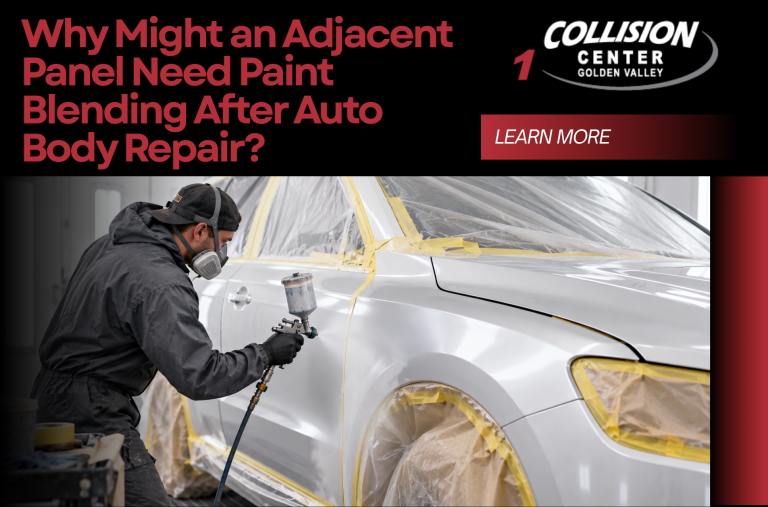
Instead of applying the new color only to the repaired panel and stopping directly at the panel edge, the refinisher may gradually extend the color into an adjacent panel.
The transition is designed to make the difference between:
- Newly refinished area
- Existing vehicle finish
less noticeable.
For example, if a front fender is repaired, the adjacent front door may be considered as part of the refinishing plan.
The door itself may have no collision damage.
Its involvement may simply help create the desired color transition.
Does Paint Blending Mean the Entire Adjacent Panel Gets a New Color?
Not necessarily.
The color coat can be gradually transitioned across part of the neighboring panel rather than being applied uniformly as a full new color coat.
The refinishing process then needs to account for the complete finish system being used.
Exact procedures vary depending on:
- Paint manufacturer
- Color
- Vehicle
- Repair
- Refinishing system
The technician should follow the applicable product and repair procedures.
Step 2: Understand Why the Paint Code Is Only a Starting Point
Vehicles have paint codes that identify their factory color.
That sounds straightforward.
If the code says a particular shade of silver, shouldn’t the shop simply mix that formula and spray the repaired panel?
In practice, achieving a visual match can involve more variables.
The paint code gives the refinisher an important starting point, but vehicles carrying the same paint code can still show variations.
Why Can the Same Paint Code Look Different?
Several factors can influence appearance.
These may include:
- Factory production variation
- Different paint batches
- Application conditions
- Age of the vehicle’s existing finish
- Previous refinishing
- Metallic or pearl orientation
Paint manufacturers may provide alternate formulas or variants for some colors.
A refinisher can use available tools and techniques to identify the formula that most closely matches the vehicle.
Step 3: Understand Why a Hard Color Stop Can Be Noticeable
Suppose the damaged fender is refinished and the color ends exactly at the edge next to the original door.
You now have:
Newly applied color | Original vehicle color
directly beside each other.
Even a relatively small difference can become easier to notice when the two finishes meet at a sharp panel boundary.
Blending helps create a more gradual transition.
Instead of forcing the eye to compare two colors directly at one edge, the refinisher transitions the color into the neighboring area.
Does That Mean the New Paint Is the Wrong Color?
No.
The need to blend does not automatically mean the paint formula is incorrect.
Automotive refinishing is about achieving an acceptable visual match on the actual vehicle.
The formula, application technique, existing finish, and surrounding panels all contribute to the result.
Blending is one technique refinishing professionals can use when appropriate.
Step 4: Understand Why Metallic Colors Can Be More Challenging
Metallic automotive finishes contain particles that contribute to the appearance of the color.
How those particles orient during application can affect how the finish looks.
The appearance can vary depending on:
- Viewing angle
- Light
- Application technique
- Paint system
That is why a metallic panel can sometimes look like a good match from one direction but appear slightly different from another.
A skilled refinisher needs to consider both:
- Color
- Effect
when matching the existing finish.
Why Can Silver Be Difficult to Match?
Silver is a familiar example because its appearance depends heavily on metallic effect.
Two finishes can be close in basic color while still appearing different because of how the metallic particles reflect light.
That can make a direct panel-to-panel comparison especially noticeable.
Blending can help soften that transition when it is appropriate for the repair.
Step 5: Understand Pearl and Multi-Stage Finishes
Some vehicles use finishes that are more complex than a straightforward solid color.
Depending on the paint system, a finish can involve multiple layers that contribute to its final appearance.
Pearl effects can change depending on:
- Application
- Number of coats
- Viewing angle
- Lighting
This can make matching the surrounding finish more involved.
The refinisher needs to follow the procedures for the particular paint system being used.
Does Every Pearl Color Require Blending?
Not automatically.
The refinishing plan depends on:
- Specific color
- Repair location
- Panel relationship
- Existing finish
- Paint system procedures
The shop should evaluate the actual vehicle instead of applying one universal blending rule to every color.
Step 6: Understand Why Lighting Changes How Paint Looks
Have you ever looked at a vehicle indoors and thought the color matched perfectly, only to notice something different outside?
Lighting can change how automotive finishes appear.
A color may look different under:
- Shop lighting
- Direct sunlight
- Shade
- Cloudy conditions
- Streetlights
Metallic and pearl colors can be particularly sensitive to changes in viewing conditions.
Professional refinishing therefore involves more than evaluating a color under one light source.
Can Two Panels Match Indoors but Look Different Outside?
Yes.
Different light sources can reveal differences that are difficult to see under shop lighting.
This is sometimes related to metamerism, where colors that appear similar under one lighting condition appear different under another.
Refinishers may evaluate color under appropriate lighting conditions before finalizing the repair.
Step 7: Understand Why the Vehicle’s Existing Finish Matters
The paint being matched is the paint currently on the vehicle.
That may not always be identical to how the vehicle looked when it first left the factory.
The finish may have been affected by:
- Age
- Environmental exposure
- Previous repairs
- Prior refinishing
Technicians therefore need to evaluate the actual vehicle rather than relying only on the factory paint code.
Does Old Paint Always Fade Dramatically?
No.
Modern automotive finishes can maintain their appearance well, and the amount of change varies considerably.
Factors can include:
- Vehicle age
- Color
- Environmental exposure
- Care
- Previous refinishing
The shop should assess the finish in front of them rather than automatically assuming the paint has faded.
Step 8: Determine Which Adjacent Panel Might Need Blending
The panel selected for blending usually depends on its relationship to the repaired area.
For example:
Damaged front fender
Possible adjacent panels:
- Front door
- Hood
Damaged front door
Possible adjacent panels:
- Fender
- Rear door
Damaged rear door
Possible adjacent panels:
- Front door
- Quarter panel
This does not mean every adjacent panel must automatically be blended.
The refinisher evaluates what is appropriate for the specific repair and color.
Does Every Panel Next to the Repair Need Blending?
No.
Blending decisions depend on the repair situation.
Factors can include:
- Color match
- Distance from repair
- Panel orientation
- Available blend area
- Paint system
- Manufacturer or refinishing procedures
Some repairs may not require blending into every neighboring panel.
Step 9: Understand Why Panel Orientation Matters
Adjacent panels do not always face exactly the same direction.
For example:
- Hood is mostly horizontal
- Fender is primarily vertical
- Door is vertical
Light strikes these surfaces differently.
That can affect how the same color appears.
A slight visual difference between panels may sometimes result naturally from:
- Panel angle
- Lighting
- Metallic orientation
rather than an actual color mismatch.
An experienced refinisher takes these relationships into account.
Step 10: Understand What Happens to the Blend Panel
If an adjacent panel is included in the refinishing process, it needs appropriate preparation.
Depending on the repair and refinishing system, that can involve:
- Cleaning
- Removing necessary trim or components
- Preparing the surface
- Applying the blend
- Applying the required finish layers
This work takes:
- Labor
- Materials
- Equipment
even though the panel was not physically damaged by the accident.
That is why you may see an adjacent panel listed on the repair estimate.
Is the Body Shop Repairing Damage That Wasn’t There?
Not necessarily.
There is an important distinction between:
Body repair
and
Refinishing operation
An undamaged door might not require dent repair.
But it may still be included in the refinishing process because it sits next to the repaired panel.
Ask the estimator:
“Is this panel being repaired, or is it included only for paint blending?”
That usually makes the estimate easier to understand.
Step 11: Understand Why Trim May Need to Be Removed
Adjacent panels can contain components such as:
- Handles
- Moldings
- Lamps
- Badges
- Weatherstrips
- Other trim
Depending on the refinishing procedure, some components may need to be removed or repositioned so technicians can properly prepare and refinish the area.
This can add labor even when the panel itself has no collision dent.
The repair plan should explain which operations are necessary.
Why Not Just Tape Around Everything?
Masking is useful in refinishing, but it is not automatically appropriate around every component.
Depending on the location and procedure, removal may help technicians:
- Prepare the surface
- Apply coatings properly
- Avoid unwanted paint edges
The appropriate approach depends on the component and refinishing requirements.
Step 12: Understand the Difference Between Blending and Painting a Complete Replacement Panel
Suppose a damaged fender must be replaced.
The replacement fender needs to be refinished.
The adjacent door might then be used as a blend panel.
These are different operations.
Replacement Fender
The new component receives the necessary refinishing process.
Adjacent Door
Color may be transitioned into the door to help create a visual match between the new finish and the existing vehicle finish.
Understanding this distinction can make a collision estimate much easier to read.
Step 13: Understand Why Color Matching Starts Before the Vehicle Is Painted
Professional color matching does not begin when the spray gun is picked up.
The refinisher may first evaluate:
- Paint code
- Available color variants
- Existing vehicle finish
- Adjacent panels
Depending on the facility and paint system, tools such as digital color-measuring technology may also assist with color selection.
A spray-out test can also help evaluate a proposed color before it is applied to the vehicle.
What Is a Spray-Out Card?
A spray-out is a test sample created using the selected paint formula and application technique.
The refinisher can compare the sample with the vehicle before proceeding.
This can help evaluate:
- Color
- Metallic effect
- Pearl appearance
It provides another piece of information for deciding whether adjustments are needed.
Step 14: Understand Why Paint Application Technique Matters
The formula is only part of the final result.
Application can also influence appearance.
Factors can include:
- Spray technique
- Coat application
- Equipment setup
- Product requirements
This is especially important with effect colors.
Professional refinishing therefore combines:
- Color information
- Product knowledge
- Technician skill
- Proper equipment
The goal is a consistent appearance across the repaired area.
Step 15: Know That Blending Does Not Correct Poor Panel Alignment
Paint blending addresses appearance of the finish.
It does not correct physical collision damage.
Before refinishing, technicians still need to address issues such as:
- Dents
- Panel distortion
- Damaged mounting points
- Uneven panel gaps
If a door and fender no longer align after an accident, paint alone will not correct the problem.
The physical collision repair should be completed before the final refinishing process.
Step 16: Understand Why OEM and Paint-System Procedures Matter
Collision repair facilities work with both vehicle repair information and refinishing-system procedures.
The I-CAR Repairability Technical Support Portal provides collision professionals with resources for researching repair procedures and refinishing-related considerations.
Paint manufacturers also establish procedures for their products.
Depending on the repair, technicians may need to consider:
- Surface preparation
- Undercoats
- Color application
- Blend procedures
- Clearcoat application
- Curing
Following the applicable process is more important than treating every paint job exactly the same.
Step 17: Understand How Insurance Fits Into Paint Blending
If your collision repair is being handled through insurance, the insurer may prepare an initial estimate.
The repair facility may prepare its own repair plan after:
- Inspecting the vehicle
- Evaluating the color
- Identifying necessary refinishing operations
- Disassembling damaged areas
Sometimes those estimates differ.
Collision Center 1 provides insurance claim assistance to help customers navigate communication during the repair process.
The Minnesota Department of Commerce also provides information for consumers about auto insurance and claims.
What if the Insurance Estimate Does Not Include Blending?
Ask the repair facility why blending is being recommended.
The shop can explain factors such as:
- Color
- Repair location
- Adjacent panels
- Refinishing requirements
When appropriate, the facility can document the operation as part of its repair plan.
Insurance coverage and technical repair recommendations are related, but they are not exactly the same question.
The insurer determines coverage.
The repair facility explains the repair process it believes is appropriate.
Step 18: Understand Why the Estimate May List an Undamaged Panel
This can initially look confusing.
Suppose the accident damaged only the front fender.
Your estimate might list:
- Repair or replace front fender
- Refinish front fender
- Blend front door
- Remove and install certain door trim
You may wonder:
“Why is my door on the estimate when it wasn’t hit?”
Because the door may be involved in creating the paint transition.
The estimate should distinguish between:
- Collision damage repair
- Refinishing-related operations
Ask the estimator to walk you through those lines if they are unclear.
Step 19: Check the Finish From More Than One Angle
When you pick up the vehicle, look at the repaired area from several positions.
Check it:
- Straight on
- From the front
- From the rear
- From different reasonable viewing angles
Lighting conditions can affect what you see.
Look at how the finish transitions across:
- Repaired panel
- Adjacent panels
Also inspect:
- Body lines
- Panel gaps
- Trim installation
Paint appearance is important, but it is only one part of the completed body repair.
What if the Color Looks Different Under One Type of Light?
Ask the repair facility about it.
Metallic, pearl, and other effect finishes can naturally change in appearance with:
- Viewing angle
- Lighting
But a noticeable concern should still be discussed.
The shop can inspect the area and explain whether what you are seeing relates to:
- Normal color travel
- Panel orientation
- Lighting
- Refinishing concern
It is better to ask than to guess.
Step 20: Ask the Right Questions About Paint Blending
If your estimate includes blending, useful questions include:
- Why does this color need blending?
- Which adjacent panel will be blended?
- Was that panel damaged or is it only part of the refinishing process?
- Does any trim need to be removed?
- Is this a metallic or pearl finish?
- How was the color matched?
- Are there color variants for my paint code?
- What refinishing procedure is being followed?
You do not need to become an automotive painter to understand your estimate.
A clear explanation should tell you why the adjacent panel is involved.
Frequently Asked Questions
Why would an undamaged panel need paint blending?
An adjacent undamaged panel may be used to create a gradual transition between newly applied color and the vehicle’s existing finish. Its inclusion does not necessarily mean it was damaged in the accident.
Doesn’t the vehicle’s paint code guarantee an exact match?
The paint code is an important starting point, but variations can exist within a factory color. The vehicle’s existing finish, color variants, paint effect, and application can all influence appearance.
Are metallic colors more likely to need careful blending?
Metallic colors can require additional attention because the orientation of metallic particles affects how the finish reflects light and appears from different angles.
Does the entire adjacent panel receive new color when it is blended?
Not necessarily. The color may be gradually transitioned into part of the adjacent panel according to the refinishing process being used.
Is paint blending the same as repairing the adjacent panel?
No. An adjacent panel can be physically undamaged but still require preparation and refinishing operations as part of the color-blending process.
Does every collision repair require paint blending?
No. Whether blending is appropriate depends on the color, repair location, adjacent panels, existing finish, paint system, and applicable procedures.
Why might trim be removed from an undamaged blend panel?
Certain trim may need to be removed so technicians can properly prepare and refinish the panel without creating undesirable paint edges around components.
Where can Golden Valley drivers have collision-related paint damage evaluated?
Golden Valley drivers can visit Collision Center 1 at 900 Florida Ave S, Golden Valley, MN 55426 for professional auto body and collision repair.
Understand Why the Adjacent Panel May Be Part of Your Golden Valley Repair
Seeing an undamaged panel listed on a collision repair estimate can be confusing.
But it does not necessarily mean the shop believes that panel was damaged.
Sometimes it is there because of the refinishing process.
Matching automotive paint involves more than entering a paint code and spraying a repaired panel.
Refinishers may need to account for:
- Existing vehicle finish
- Color variants
- Metallic or pearl effects
- Panel orientation
- Lighting
- Application technique
When appropriate, blending into the adjacent panel can create a smoother visual transition between the repaired area and the existing finish.
The important thing is understanding why blending is part of your specific repair, rather than assuming every neighboring panel automatically needs paint.
Golden Valley drivers can learn more about Collision Center 1’s auto body repair, collision repair, and OEM certifications, or visit the Golden Valley location to have collision-related body and paint damage evaluated.
Collision Center 1 – Golden Valley
900 Florida Ave S Golden Valley, MN 55426