
SUMMARY
- Collision repair on a GMC HUMMER EV should account for both the visible body damage and the vehicle’s electric-vehicle systems, construction, electronics, and manufacturer repair procedures.
- A dented fender, door, bedside, rocker area, or bumper does not automatically mean the high-voltage battery was damaged. The location and severity of the collision determine what needs inspection.
- The HUMMER EV’s high-voltage system adds procedures and precautions that do not apply to conventional gasoline-only vehicles. GM service information includes specific high-voltage disabling and verification procedures for EV service work.
- GMC documents that HUMMER EV models can have steel shielding around the drive unit and battery pack, with additional underbody protection available on certain configurations.
- An impact underneath the vehicle or around the rocker and lower-body areas deserves careful evaluation because of the EV components and protective structures located below the vehicle.
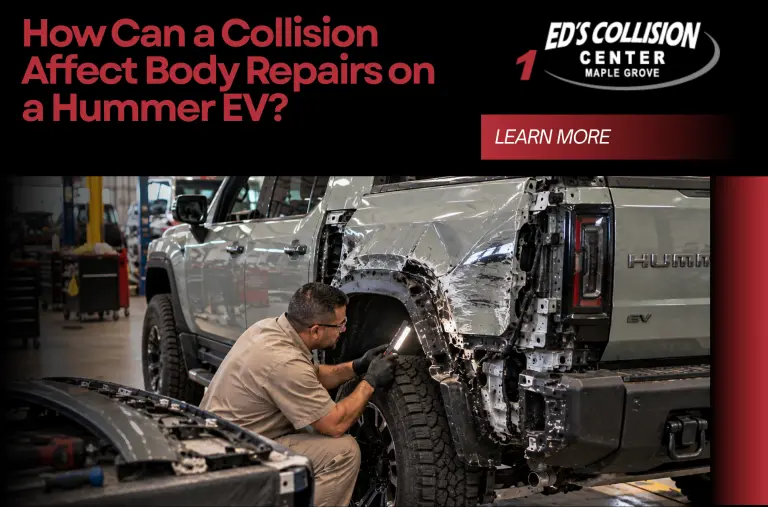
- Modern HUMMER EVs also contain cameras, sensors, wiring, lighting, and other electronic equipment that may need consideration after collision damage.
- Repair-versus-replacement decisions should be based on the specific HUMMER EV model, model year, damaged component, material, and current GM repair procedures.
- Disassembly may reveal additional brackets, mounting points, wiring, or underlying body damage that was not visible during the initial estimate.
- GMC says facilities in the GM Collision Repair Network have access to OEM repair procedures, tools, training, and validation for GM vehicles.
- Maple Grove HUMMER EV owners can have collision damage evaluated at Ed’s Collision 1, 10758 County Rd 81, Maple Grove, MN 55369.
Your HUMMER EV Has Body Damage. Is Repairing It Different From a Regular Vehicle?
It can be.
The basic goals of collision repair remain familiar:
- Identify the damage
- Determine what can be repaired
- Determine what needs replacement
- Restore panel alignment
- Refinish repaired areas
- Verify affected vehicle systems
But the GMC HUMMER EV is an electric vehicle with a large high-voltage propulsion system and extensive electronics.
That means technicians cannot look only at the dent.
They also need to consider where the collision occurred and what components are located near that area.
A dent in an upper door and an impact underneath the vehicle can present very different repair considerations.
Step 1: Identify the Exact HUMMER EV
Start by identifying the exact vehicle.
The HUMMER EV is available in:
- Pickup configurations
- SUV configurations
- Different model years
- Different equipment packages
The exact configuration matters because vehicle equipment can vary.
Technicians should identify:
- Model year
- Pickup or SUV
- Installed equipment
- Collision location
- Components requiring repair or replacement
The repair plan should then use current GM information applicable to that vehicle.
Why Does Model Year Matter?
Manufacturers can update vehicles over time.
Changes can involve:
- Components
- Electronics
- Software
- Repair procedures
- Replacement parts
- Driver-assistance equipment
The fact that a procedure applied to an earlier HUMMER EV does not automatically mean it should be applied to every later model.
Current vehicle-specific information should guide the repair.
Step 2: Start With the Collision Location
One of the first questions should be:
Where was the HUMMER EV hit?
A collision could involve the:
- Front bumper
- Front corner
- Fender
- Door
- Rocker area
- Rear quarter
- Pickup bed
- Rear bumper
- Wheel
- Underbody
Each location creates different inspection priorities.
A minor door dent may primarily involve body and refinishing work.
A significant impact underneath the vehicle can raise additional questions because the HUMMER EV’s propulsion components are located below the passenger compartment.
Step 3: Understand Why the High-Voltage System Changes the Repair Environment
Electric vehicles contain high-voltage electrical components.
That means technicians need to follow appropriate safety procedures when work involves or could affect high-voltage areas.
GM service information for its electric vehicles includes detailed procedures for disabling high voltage, verifying voltage conditions, and using appropriate personal protective equipment when servicing high-voltage components.
This is different from simply disconnecting a conventional 12-volt battery.
The repair facility needs to know:
- Whether high-voltage procedures apply
- Which areas technicians will be working around
- What GM specifies before beginning that work
Does Every Body Repair Require the High-Voltage Battery to Be Removed?
No.
Do not assume that every dent or bumper repair on a HUMMER EV requires battery removal.
The necessary procedures depend on factors such as:
- Collision location
- Repair operation
- Components involved
- GM service information
A relatively isolated exterior repair can be very different from collision damage involving the lower body or battery area.
The correct procedure should be determined for the specific repair.
Step 4: Understand Where Underbody Protection Fits Into the Vehicle
The underside of the HUMMER EV deserves special attention after certain collisions.
GMC says available full underbody armor uses steel plates and shields around the drive unit and battery pack. Depending on configuration, additional skid plates and rocker protection may also be present.
This becomes especially relevant after impacts involving:
- Road debris
- Curbs
- Large objects
- Off-road obstacles
- Undercarriage contact
Visible exterior body damage may not tell technicians everything about what happened underneath.
Does Damaged Underbody Protection Mean the Battery Is Damaged?
Not automatically.
Protective shielding and the battery are different components.
Damage to a shield does not by itself prove that the battery pack underneath has been damaged.
Likewise, technicians should not assume the battery is unaffected without appropriate inspection when the impact occurred in that area.
The damage needs to be evaluated according to GM procedures.
Step 5: Pay Attention to Rocker-Area Damage
The rocker area runs below the doors along the side of the vehicle.
On an EV, a collision in this lower-body area deserves careful evaluation because of its proximity to underbody and propulsion-system components.
A rocker impact might involve:
- Exterior trim
- Body structure
- Protective components
- Mounting areas
The exact construction and repairability need to be researched for the specific HUMMER EV.
Can a Rocker Dent Simply Be Pulled Out?
That depends on what is actually damaged.
Technicians need to determine:
- Which component is dented
- What material it uses
- Whether the area is structural
- What sits behind it
- Whether GM permits the proposed repair
A repair technique should not be chosen only because the damage looks similar to a dent on a conventional vehicle.
Step 6: Inspect Front-End Damage Beyond the Bumper
A HUMMER EV front-end collision can visibly damage:
- Bumper
- Hood
- Fender
- Grille area
- Lamps
But technicians may also need to inspect components behind those areas.
Depending on the collision, these can include:
- Brackets
- Mounting points
- Wiring
- Electronic equipment
- Cooling-related components
A cracked bumper cover may be the first visible sign, not necessarily the complete repair.
Step 7: Consider the HUMMER EV’s Power eTrunk®
The HUMMER EV includes a front storage area called the Power eTrunk®. GMC lists the feature on current HUMMER EV Pickup and SUV models.
A front collision can therefore involve more than a traditional engine-compartment layout.
Technicians need to inspect the actual components and mounting areas affected by the impact.
If the front storage system no longer:
- Opens normally
- Closes normally
- Aligns correctly
mention that change during the collision assessment.
Step 8: Inspect Lamps and Their Mounting Areas
A front- or rear-corner collision can affect exterior lighting.
Technicians should look beyond whether the lamp turns on.
The collision can potentially damage:
- Lens
- Housing
- Mounting tabs
- Brackets
- Wiring
- Connectors
- Surrounding mounting areas
A lamp can still illuminate while its physical mounting has shifted.
Panel fit and lamp position should therefore be checked along with electrical operation.
Step 9: Check Panel Gaps
Panel gaps can provide clues about how collision forces traveled.
Inspect spaces around:
- Hood
- Doors
- Fenders
- Tailgate or rear gate
- Bumpers
Look for areas that suddenly became:
- Wider
- Narrower
- Uneven
A changed panel gap does not automatically prove structural damage.
Possible causes can include:
- Bent panel
- Broken bracket
- Damaged hinge
- Shifted mounting point
- Underlying body movement
The technician needs to identify the actual cause.
Step 10: Understand Repair Versus Replacement Decisions
Not every damaged HUMMER EV panel automatically needs replacement.
Likewise, replacement should not be avoided when the damaged component or manufacturer procedure requires it.
Technicians can consider:
- Material
- Dent depth
- Creasing
- Stretching
- Cracks or tears
- Panel edges
- Mounting locations
- GM repair information
The decision should be based on the actual component rather than simply the size of the visible dent.
Can Paintless Dent Repair Be Used on a HUMMER EV?
Potentially, for appropriate exterior dents.
Paintless dent repair may be considered when factors such as these are favorable:
- Paint remains intact
- Dent shape is suitable
- Panel material supports the technique
- Damage is accessible
But accessibility is especially important.
Technicians need to understand what is behind the panel before using tools in an area containing wiring, electronics, or other vehicle systems.
Step 11: Identify the Material Before Repairing the Panel
Modern vehicles can use different materials across different parts of the body.
Technicians should not assume every HUMMER EV exterior component uses the same material.
Before:
- Straightening
- Welding
- Sectioning
- Replacing
a component, the repair facility should identify what it is working with and research the applicable GM procedure.
GM notes that it updates production and service-part designs as new materials and technologies are integrated into its vehicles.
That is another reason vehicle-specific repair information matters.
Step 12: Understand Why Joining Methods Matter
When collision damage requires component replacement, the new component has to be installed according to the applicable procedure.
Depending on the part, manufacturer procedures can address:
- Attachment locations
- Welding
- Adhesives
- Mechanical fasteners
- Other joining processes
Technicians should not assume that a replacement panel is installed the same way on every vehicle.
Collision Center 1 maintains multiple OEM certifications across its repair network.
The repair plan should use the procedures applicable to the HUMMER EV component being replaced.
Step 13: Consider Wheel and Suspension Damage
The HUMMER EV is a large, heavy electric vehicle, but the same basic rule applies after a wheel-area collision:
Inspect what was actually hit.
If the impact involved a wheel, technicians may need to evaluate the:
- Wheel
- Tire
- Suspension
- Steering-related components
- Wheelhouse
- Nearby body areas
Tell the repair facility if you notice:
- Pulling
- Vibration
- Steering changes
- New noises
- Wheel sitting differently
These symptoms can help guide the inspection.
Is Wheel Alignment Enough After a Wheel Impact?
Not necessarily.
Alignment adjusts specified wheel angles.
It does not repair a physically damaged:
- Wheel
- Suspension component
- Steering component
Technicians should first determine whether physical collision damage exists.
Alignment can then be performed when appropriate.
Step 14: Consider Cameras, Radar, and Driver-Assistance Equipment
The HUMMER EV includes modern electronic driver-assistance technology.
Depending on model year and configuration, collision repairs can occur near:
- Cameras
- Radar
- Parking sensors
- Other electronic equipment
The National Highway Traffic Safety Administration explains how cameras, radar, and other technologies are used in modern driver-assistance systems.
The repair facility should determine whether the collision or repair affected any relevant equipment or mounting areas.
Does Every HUMMER EV Collision Require ADAS Calibration?
No.
Calibration requirements depend on:
- Collision location
- Components affected
- Parts removed or replaced
- Vehicle equipment
- GM procedures
A bumper scratch and a significant front-end collision should not automatically receive the same repair plan.
Technicians should research the specific vehicle and repair.
Step 15: Understand the Difference Between Scanning and Calibration
These terms are sometimes used together, but they describe different procedures.
Diagnostic Scanning
A scan communicates with electronic modules and can identify diagnostic information or trouble codes.
Calibration
Calibration establishes or verifies specified operating parameters for certain cameras, radar units, sensors, or related systems when required.
A repair might require:
- Scanning
- Calibration
- Both
- Neither
The answer depends on GM procedures and the work performed.
Step 16: Understand Why EV Repairs Require Additional Training
Electric vehicles introduce hazards and systems that conventional body repairs may not involve.
Technicians working around high-voltage components need to understand:
- EV safety
- High-voltage procedures
- Required protective equipment
- Vehicle-specific service information
GMC says its Collision Repair Network facilities offer expertise involving OEM repair procedures, tools, training, and validation for GM vehicles.
The important question for a HUMMER EV owner is not simply:
“Does this shop repair dents?”
It is also:
“Does the repair process account for the technology and procedures on this specific EV?”
Step 17: Understand Why Lifting the Vehicle Matters
Body shops frequently need to raise vehicles for:
- Underbody inspection
- Wheel and suspension work
- Measurements
- Other repairs
Electric vehicles require attention to manufacturer-specified lifting locations because of the equipment underneath the vehicle.
GM EV service information warns technicians to use specified lifting locations during service procedures.
For a HUMMER EV collision repair, technicians should follow the lifting information applicable to the exact model and model year.
Step 18: Inspect Underbody Damage After an Impact
If the collision involved something passing underneath the vehicle, tell the repair facility.
Possible evidence includes:
- Scraped shields
- Bent protection
- Loose panels
- New warning messages
- Fluid leaks
- New noises
Do not assume that a scrape means the battery is damaged.
But do not ignore a significant underbody impact either.
The appropriate inspection should determine what actually made contact and whether additional procedures are needed.
Step 19: Understand Why Battery Concerns Need Proper Evaluation
The high-voltage battery is a major component of the HUMMER EV.
Customers may understandably worry about it after any collision.
But battery damage should not be diagnosed from the exterior dent alone.
The repair facility needs to consider:
- Impact location
- Underbody condition
- Protective components
- Vehicle warnings
- GM inspection procedures
The result could be that the battery area was not involved.
Or the collision could require further evaluation.
The important point is to inspect based on evidence rather than assumptions.
Step 20: Consider the Pickup Bed or SUV Rear Body Separately
The HUMMER EV Pickup and HUMMER EV SUV have different rear-body designs.
For example, GMC lists a MultiPro™ Tailgate as standard on the HUMMER EV Pickup, while the SUV uses a Power Rear Gate.
Rear collision repairs therefore need to account for the specific body configuration.
Depending on the impact, technicians may need to inspect:
- Rear body panels
- Tailgate or rear gate
- Hinges
- Latches
- Lamps
- Cameras
- Wiring
- Bumper components
The repair plan should match the actual HUMMER EV configuration.
Step 21: Do Not Forget Corrosion Protection
Body repairs can disturb protective materials.
Depending on the repair, technicians may need to restore appropriate:
- Coatings
- Seam sealers
- Cavity protection
- Other corrosion-protection materials
Some of these operations become invisible after reassembly.
They still matter.
A complete body repair should address both the visible finish and applicable protection underneath it.
Step 22: Understand Paint Matching and Refinishing
Once physical body repairs are complete, repaired panels may need refinishing.
Color matching can involve:
- Paint code
- Color variants
- Existing finish
- Metallic or pearl effect
- Panel orientation
Depending on the repair, paint may also be blended into an adjacent panel to create a smoother visual transition.
An adjacent panel appearing on the estimate does not necessarily mean it was damaged in the collision.
It may be included as part of the refinishing process.
Step 23: Understand Why Disassembly Can Change the Estimate
The first estimate may be based on visible damage.
For example:
Initial Inspection
Technicians identify:
- Damaged bumper
- Dented fender
- Broken lamp
After Disassembly
They may identify:
- Broken mounting bracket
- Additional body damage
- Damaged wiring
- Another collision-related component
The repair plan can then be updated.
This is particularly important on a technology-heavy vehicle where many components may sit behind exterior panels.
Does an Updated Estimate Mean the Shop Missed Something?
Not necessarily.
Some components simply cannot be fully inspected until the damaged exterior parts are removed.
A supplement allows additional documented collision damage or required operations to be added to the repair plan.
Ask:
“What did you find during disassembly, and how does it change the repair?”
That keeps the process transparent.
Step 24: Understand How Insurance Fits Into HUMMER EV Repairs
Insurance may be involved in decisions about:
- Parts
- Labor
- Supplements
- Payment
- Covered operations
But the technical repair requirements still need to be identified.
Collision Center 1 offers insurance claim assistance to help customers navigate communication during collision repairs.
The Minnesota Department of Commerce provides consumer information about auto insurance and claims.
GMC also states that vehicle owners can choose where their vehicle is repaired after a collision.
Step 25: Ask the Right Questions Before Authorizing HUMMER EV Repairs
Useful questions include:
- What collision damage did you find?
- Is there any underbody damage?
- Was the battery area involved?
- Do high-voltage safety procedures apply to this repair?
- What body materials are involved?
- Which panels can be repaired?
- Which components require replacement?
- What GM procedures apply?
- Does the vehicle need diagnostic scanning?
- Does any camera or sensor require calibration?
- Was the wheel or suspension involved?
- What happens if additional damage is discovered?
- What documentation will I receive?
You do not need to understand the complete electrical architecture of your HUMMER EV.
The repair facility should be able to explain why each major operation is part of the repair plan.
Frequently Asked Questions
Is collision repair on a HUMMER EV different from repairing a gasoline vehicle?
It can be. The HUMMER EV has a high-voltage propulsion system and extensive electronics that can require EV-specific safety and repair procedures in addition to conventional body and refinishing work.
Does every HUMMER EV collision damage the high-voltage battery?
No. Battery involvement depends on the location and severity of the collision. A damaged exterior body panel does not automatically mean the battery pack is damaged.
Why should the underbody be checked after certain HUMMER EV accidents?
The HUMMER EV’s drive and battery components are located underneath the vehicle, with protective shielding around those areas. Significant underbody impacts should therefore be evaluated to determine what was actually affected.
Can a dented HUMMER EV body panel be repaired instead of replaced?
Potentially. The decision depends on the damaged component, material, severity, accessibility, and applicable GM repair procedures.
Can paintless dent repair be used on a HUMMER EV?
Sometimes. Suitable exterior dents may qualify for PDR when the paint, panel material, dent shape, accessibility, and surrounding components allow the technique.
Does every HUMMER EV collision require ADAS calibration?
No. Calibration depends on the vehicle equipment, collision location, components affected, repairs performed, and applicable GM procedures.
Why might a HUMMER EV collision estimate change after repairs begin?
Disassembly can reveal damaged brackets, mounting points, wiring, underlying body components, or other collision-related damage that could not be confirmed during the initial exterior inspection.
Where can Maple Grove drivers have HUMMER EV collision damage evaluated?
HUMMER EV owners can visit Ed’s Collision 1 at 10758 County Rd 81, Maple Grove, MN 55369 for a professional collision damage assessment.
Give a HUMMER EV Repair More Than a Surface-Level Inspection in Maple Grove
A dent is still a dent.
A cracked bumper is still a cracked bumper.
But on a HUMMER EV, the repair plan may need to consider much more than what is visible from outside.
Depending on the collision, that can include:
- Body materials
- Mounting areas
- High-voltage safety
- Underbody protection
- Battery-area inspection
- Wheels and suspension
- Cameras and sensors
- Diagnostic scanning
- Calibration
- Manufacturer repair procedures
That does not mean every HUMMER EV collision automatically becomes a complicated battery repair.
The right approach is more practical:
Find out what was actually affected, then follow the procedures that apply to those components.
GMC specifically points owners toward repair facilities with access to OEM procedures, tools, training, and GM-specific repair knowledge after a collision.
Maple Grove drivers can learn more about auto body repair, collision repair, and OEM certifications, or visit the Maple Grove location for a collision damage evaluation.
Ed’s Collision 1
10758 County Rd 81 Maple Grove, MN 55369