
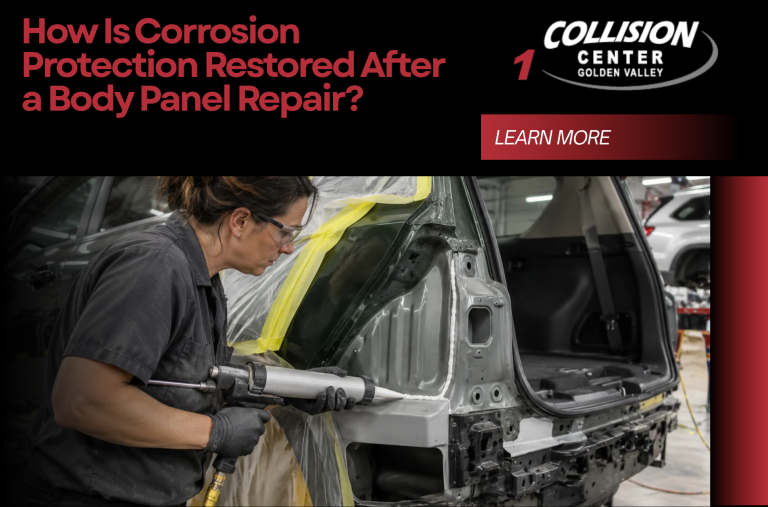
SUMMARY
- Corrosion protection is a core part of professional body panel repair because sanding, welding, panel replacement, and refinishing can remove or disturb the coatings a vehicle received at the factory.
- Collision damage can crack paint, scrape primer, and tear seam sealer, which may let moisture reach bare metal even when a dent looks minor.
- Restoring corrosion protection usually involves more than paint. Depending on the vehicle, technicians may need corrosion-resistant primer, seam sealer, cavity wax, and underbody coatings.
- Vehicle manufacturers publish repair procedures that specify which protective materials a repaired or replaced panel needs and where technicians should apply them.
- Surface preparation matters because dirt, oil, moisture, or leftover rust can keep protective coatings from bonding properly.
- Welded seams, panel flanges, and enclosed cavities often need extra attention, since moisture can collect in areas that are hard to inspect.
- Steel and aluminum panels have different corrosion behavior, so the correct materials and methods depend on what the damaged part is made of.
- Minnesota winters raise the stakes, because road salt, slush, and moisture can speed up corrosion on any surface that lost its protection.
- Proper corrosion protection helps preserve the repaired area over time, although no coating can guarantee that corrosion will never develop.
- Golden Valley drivers can have body panel damage and corrosion protection needs evaluated at Collision Center 1 Golden Valley, 900 Florida Ave S, Golden Valley, MN 55426.
Introduction
After a collision, most drivers focus on what they can see.
They want the dent gone, the panel straight, and the paint matched.
However, every vehicle also carries layers of protection that most people never notice:
- Factory coatings applied to the bare metal
- Primers designed to resist corrosion
- Seam sealer in designated body joints
- Wax-based treatments inside enclosed cavities
- Underbody coatings along the lower body
A collision can damage these layers. In addition, the repair itself can disturb them when technicians sand, straighten, cut, or weld metal.
That is why corrosion protection deserves attention during any body panel repair. If the repair restores the appearance but leaves vulnerable metal or seams untreated, moisture can eventually reach those areas.
For drivers in Golden Valley and the surrounding Twin Cities, this matters even more. Snow, slush, and road salt arrive every winter, and they put unprotected metal under constant stress.
So the real question after a body panel repair is not only “Does it look right?”
It is also “Did the repair restore the protection my vehicle needs underneath the finish?”
Collision Center 1 Golden Valley provides professional auto body repair for damaged panels and collision-related refinishing.
This guide explains how technicians restore corrosion protection, which materials may be involved, and what you can ask before you pick up your vehicle.
What Is Automotive Corrosion Protection?
Automotive corrosion protection is the combination of materials and processes that helps keep vehicle metals from deteriorating when they meet moisture, oxygen, and salt.
Modern vehicles rarely rely on a single coating. Instead, manufacturers build several layers that each do a specific job.
Depending on the vehicle and component, these can include:
- Factory-applied conversion coatings
- Electrocoat, often called E-coat
- Corrosion-resistant primers
- Seam sealers
- Cavity protection materials
- Underbody coatings
- Basecoat and clearcoat refinishing systems
Each layer covers a different weakness. For example, paint protects exposed exterior surfaces, while cavity wax protects enclosed areas that paint never reaches.
Why Do Vehicles Need Multiple Protective Layers?
Different parts of a vehicle face different conditions.
An exterior door skin sees sunlight, rain, and car washes. Meanwhile, a rocker panel interior collects condensation, and the underbody takes direct road spray and gravel.
Because the exposure differs, manufacturers specify different corrosion protection for each area. A coating system that works well on an outer panel may not suit an enclosed rail or a wheelhouse.
Requirements also vary by manufacturer, model, component, and repair procedure. As a result, technicians cannot assume that every vehicle uses the same materials.
How Does a Collision Damage Factory Corrosion Protection?
A collision can compromise protective coatings even when the panel itself does not need replacement.
Common examples include:
- Deep scratches that cut through the paint system
- Chipped paint along an impact line
- Cracked paint around a dent
- Bent panel edges and flanges
- Disturbed or cracked seam sealer
- Scraped rocker panels
- Torn underbody coatings
- Distorted panel joints
Once moisture finds a path through these openings, it can reach metal that the factory originally sealed.
Can a Small Dent Expose Bare Metal?
Yes, it can.
If an impact cracks the paint, primer, or E-coat, moisture can reach the metal underneath. Small cracks around a dent are easy to overlook, especially on darker colors or curved surfaces.
On the other hand, some dents leave the paint completely intact. In those cases, the factory corrosion protection may still be in place, and less invasive repair methods may be possible.
The depth and type of damage, therefore, decide which protective layers technicians need to restore.
Can Rust Spread Beneath Damaged Paint?
Yes.
When moisture reaches susceptible metal through a chip or crack, corrosion can begin at that spot and then creep beneath the surrounding coating. Over time, the paint may bubble or lift even though the original opening was small.
That is one reason technicians look past the visible scratch and check the condition of the coatings around it.
Does Every Scratch Expose Bare Metal?
No.
Some scratches only affect the clearcoat or the upper color layer. Those scratches may still need refinishing for appearance, but the metal underneath often remains protected.
Deeper scratches, however, can cut through primer and E-coat. Technicians usually inspect the scratch closely to judge how many layers the damage reached before choosing a repair method.
How Is Corrosion Protection Restored During a Body Panel Repair?
The exact process depends on the vehicle, the damaged component, and the manufacturer’s repair instructions. Still, a typical repair often follows a sequence like this:
- Inspect the damage. Technicians identify where paint, primer, seam sealer, or other protective materials were compromised, including edges, joints, and hidden areas.
- Research the repair procedure. The repair team looks up which corrosion protection materials and methods the manufacturer requires for that vehicle and panel.
- Remove damaged coatings and existing corrosion. Technicians prepare the affected surfaces according to the repair and coating procedures.
- Repair or replace the panel. The damaged component is straightened, sectioned, or replaced using approved methods.
- Prepare the surface. The repaired area is cleaned and prepared for the specified coating system.
- Apply primers and coatings. Technicians apply the corrosion-resistant materials the product and manufacturer call for.
- Restore seam sealer and cavity protection. When required, protective materials go back into seams, joints, and enclosed areas.
- Refinish and inspect. The panel receives its color and clearcoat, and the completed repair gets a final inspection.
Not every repair needs every step. For instance, a light scratch on an intact panel may only require refinishing, while a replaced quarter panel may involve all eight.
Why Do Manufacturer Repair Procedures Matter for Corrosion Protection?
Vehicle manufacturers design their corrosion protection around specific materials, joint designs, and assembly methods. Consequently, they also publish instructions for restoring it after a repair.
These procedures can specify:
- Which primer to use on bare or welded metal
- Where seam sealer belongs and what type to use
- Which cavities need wax or other internal protection
- How to protect weld zones and flanges
- What to do with replacement panels before and after installation
Following these instructions helps the repaired area match the protection the vehicle originally had. The I-CAR Repairability Technical Support portal is one resource collision professionals use to research manufacturer-specific corrosion protection and seam sealing procedures.
Why Is Surface Preparation Important Before Applying Corrosion Protection?
Protective coatings only work when they bond properly to a clean, correctly prepared surface.
Several things can interfere with that bond:
- Dirt and road film
- Oil or wax residue
- Moisture
- Leftover corrosion
- Improper sanding
- Incompatible coating products
For example, if a technician sprays primer over rust that was not fully treated, the corrosion can keep developing under the new finish. Similarly, contamination on the surface can lead to peeling or blistering later.
Steel, aluminum, and other materials also have different preparation requirements. That is why technicians follow both the manufacturer’s repair procedure and the coating supplier’s product instructions.
What Role Does Primer Play in Corrosion Protection?
Primer is a foundation layer in most automotive refinishing systems, and some primers are specifically formulated to help resist corrosion on suitable metal surfaces.
However, primers are not interchangeable. Different products serve different purposes, such as adhesion, filling, sealing, or corrosion resistance.
A few points to keep in mind:
- The substrate must be compatible with the primer and properly prepared.
- Primer is usually one part of a complete coating system, not a replacement for basecoat and clearcoat.
- Using the wrong product or the wrong application method can weaken adhesion and durability.
In short, the right primer in the right place is a key part of restoring corrosion protection after bare metal has been exposed.
How Is Seam Sealer Restored After a Collision Repair?
Seam sealer fills designated joints where two panels meet, which helps keep water and contaminants out of the seam.
Body panel repairs often disturb this material. Straightening, sectioning, and panel replacement can crack, tear, or remove the factory sealer.
Depending on the vehicle, seam sealer commonly appears in:
- Door openings
- Trunk floors
- Wheelhouses
- Rocker panels
- Floor joints
- Quarter panel connections
- Roof joints
When technicians restore seam sealer, they choose a material suited to that location and apply it where the manufacturer specifies. Seam sealer does not replace primer, though. In many repairs, both are required.
Why Is Cavity Wax Important After Body Panel Repair?
Cavity wax is a protective material designed for enclosed areas inside the body where moisture can collect and where paint cannot reach.
Depending on the vehicle, cavity protection may be needed in:
- Rocker panels
- Pillars
- Door interiors
- Quarter panel cavities
- Structural rails
- Other enclosed body sections
These spaces are vulnerable because water can enter through drain holes, seams, or openings and then sit where nobody can see it. Repairs that involve welding or replacing panels may burn off or remove the original cavity coating.
Not every repaired panel needs cavity wax. Instead, the component and the manufacturer’s instructions determine where technicians apply it.
How Is Corrosion Protection Restored After Welding?
Welding generates heat that can burn away nearby coatings, and the surrounding metalwork can strip protection from flanges and joints.
After welding, the following areas may need attention:
- Welded joints
- Adjacent exposed metal
- Panel flanges
- Structural cavities
- Repaired seams
Some protective materials may be applied before welding at designated stages, while others go on afterward. Because access can become difficult once a replacement panel is installed, technicians plan the sequence ahead of time.
The correct process depends on the materials, the joint design, and the manufacturer’s procedure, so welded repairs do not all receive identical corrosion protection.
How Are Replacement Body Panels Protected Against Corrosion?
Many replacement panels arrive with a factory-applied coating, such as E-coat. That coating helps, but it may not cover every need of the repair.
For instance, technicians may need to add protection to:
- Cut edges from sectioning
- Weld locations
- Panel flanges
- Seams between new and existing panels
- Bare metal exposed during fitting
- Enclosed cavities behind the new panel
In addition, the factory coating on a new part still needs a compatible primer and refinishing system before it matches the rest of the vehicle. Manufacturer documentation explains what each replacement component requires.
How Does Corrosion Protection Differ Between Steel and Aluminum Panels?
Many modern vehicles combine steel and aluminum, and the two metals behave differently.
Unprotected steel can form iron oxide, commonly called rust, when exposed to moisture and oxygen. Aluminum does not rust in the same way, but it can still corrode in other forms.
Furthermore, when dissimilar metals touch in the presence of moisture and salt, galvanic corrosion can develop. That is why repair procedures for mixed-material areas often call for specific fasteners, isolators, adhesives, or coatings.
Aluminum panels also tend to require different preparation and compatible products. Correctly identifying the material, therefore, is an important first step in the repair. For more on this topic, see how damaged aluminum body panels are evaluated after a Ford collision.
Why Is Underbody Corrosion Protection Important After Collision Repair?
The underside of a vehicle takes constant abuse from road spray, gravel, water, and winter road treatments.
A collision, especially one involving a curb, a lower impact, or a towing incident, can scrape or tear underbody coatings in areas such as:
- Floor panels
- Wheelhouses
- Rocker panels
- Lower structural members
- Lower body seams
- Underbody mounting areas
When the manufacturer calls for underbody protection, technicians restore it as part of the repair. Keep in mind that underbody coating and cavity wax are different products with different jobs, so one does not replace the other.
Why Do Minnesota Winters Make Rust Prevention More Important?
Golden Valley and the surrounding Twin Cities see months of snow, slush, and treated roads every year. As a result, damaged or unprotected metal faces more corrosion exposure here than in milder climates.
Several winter factors work together:
- Road salt dissolves in moisture and can accelerate electrochemical corrosion.
- Slush packs into wheel arches and lower body areas and stays there.
- Repeated freezing and thawing can widen small cracks in coatings.
- Vehicles often sit wet in garages, which keeps moisture in contact with metal.
Lower body areas such as rocker panels, wheel arches, and lower doors take the most road spray. Consequently, collision damage in these areas deserves prompt attention.
Leaving exposed metal untreated through a Minnesota winter can increase the risk of deterioration. Restoring that protection before the worst of the season arrives helps limit that exposure.
Can Paintless Dent Repair Preserve Factory Corrosion Protection?
Sometimes, yes.
Paintless dent repair, or PDR, reshapes certain dents without sanding or repainting the panel. When the original paint is intact and the technician can access the back of the panel, PDR can leave the factory coatings in place.
There are limits, however:
- PDR does not repair cracked or chipped paint.
- It does not remove or treat existing rust.
- Accessing the panel may disturb interior coatings, so technicians still evaluate the area afterward.
When paint is cracked, metal is exposed, or the dent is beyond PDR limits, conventional body repair and full corrosion protection restoration are usually necessary.
What Happens If Corrosion Protection Is Not Restored Properly?
If a repair leaves vulnerable metal or seams untreated, moisture and contaminants can reach them over time.
Possible results include:
- Surface rust
- Corrosion beneath new paint
- Paint blistering or bubbling
- Coating separation
- Rust along seams
- Deterioration of panel edges
- Corrosion inside enclosed cavities
Some of these problems stay hidden for a long time. For example, corrosion inside a rocker panel or behind a sealed seam may not show on the outside until it has spread.
Paint defects can have other causes, though, so a single blemish does not automatically mean the corrosion protection failed.
Can Untreated Repairs Affect a Vehicle’s Long-Term Condition?
Yes.
Corrosion can affect appearance first, with discoloration, bubbling, and flaking paint. Over a longer period, severe corrosion in structural areas can weaken components.
Deterioration may also enlarge the damaged area, which can make a future repair more involved. Proper protective treatment reduces these risks, although it cannot guarantee that corrosion will never occur. Regular washing, especially during winter, and periodic inspections also help catch problems early.
How Can You Tell If a Repaired Panel Is Starting to Rust?
Some warning signs appear gradually. Watch for:
- Rust-colored spots or streaks
- Paint bubbling or blistering
- Flaking or peeling paint
- Discoloration near seams
- Corrosion along panel edges
- Moisture collecting inside doors or cavities
If you notice any of these, avoid scraping the area yourself. Instead, have a qualified auto body shop inspect it first, since disturbing the coating can make the problem worse.
Keep in mind that new rust does not always mean the earlier repair was wrong. Stone chips, new damage, environmental exposure, and older repairs can all play a role. Panels that sit unevenly can also trap moisture, so it helps to know what uneven panel gaps mean after an accident.
Does Refinishing Alone Restore Corrosion Protection?
Not always.
A properly applied paint system protects the visible surface of a repaired panel. However, it does not reach enclosed cavities, it does not seal joints, and it may not cover the back side of a replaced part.
That is why a complete repair can combine refinishing with primer, seam sealer, cavity wax, and underbody coating. Refinishing also has its own considerations, such as color matching. In some repairs, technicians blend paint into neighboring panels, which is explained in why an adjacent panel might need paint blending after auto body repair.
Does an Auto Body Repair Warranty Cover Rust?
It depends on the repair facility’s written warranty and on what caused the corrosion.
Collision Center 1 backs its repairs with a limited lifetime warranty on repair work and paint for as long as you own the vehicle. Parts are covered according to the applicable manufacturer warranty. As with any warranty, its written terms and conditions apply.
A few practical points:
- New stone chips, scratches, or collision damage usually fall outside the original repair.
- Keeping invoices and warranty documents helps show what work was performed.
- Asking how the warranty treats corrosion before the repair begins avoids surprises later.
The Federal Trade Commission’s auto repair basics guide also explains what to look for in repair estimates, warranties, and documentation.
How Long Does It Take to Restore Corrosion Protection?
The time depends on the repair.
Refinishing a scratched panel may add little time, while a panel replacement with welding, seam sealing, and cavity protection involves more steps and curing time. Some coatings and sealers need specific drying periods before the next layer goes on.
Rushing these steps can compromise adhesion. A repair plan that accounts for corrosion protection from the start, therefore, helps keep the timeline realistic.
Should You Delay Repairs on Exposed Metal Until Spring?
Generally, it is better not to wait.
Once metal is exposed, every week of salt and moisture adds risk. Small scratches and chips can turn into larger corrosion problems by spring.
If a full repair is not possible right away, ask a body shop to inspect the damage and explain your options. At minimum, knowing the extent of the exposure helps you make an informed decision.
What Questions Should You Ask About Corrosion Protection Before Pickup?
Consider asking the repair facility:
- Were any factory protective coatings damaged?
- Does the repair require corrosion-resistant primer?
- Will damaged seam sealer be replaced?
- Are any enclosed cavities affected, and do they need cavity protection?
- How will welded areas be protected?
- Are replacement panels treated according to manufacturer procedures?
- Will underbody coatings be restored where needed?
- How will the finished repair be inspected?
- What warranty applies to the paint and repair work?
You do not need to understand every technical step yourself. Instead, these questions help you confirm that the repair plan covers more than the visible damage.
Why Choose Collision Center 1 Golden Valley for Body Panel Repair?
Restoring a damaged panel properly means paying attention to the coatings, seams, and cavities underneath the finish, not just the shape and color.
Collision Center 1 has served Minnesota drivers since 1962. At the Golden Valley location:
- The shop holds I-CAR Gold shop certification.
- Technicians carry I-CAR Platinum certifications.
- Collision Center 1 holds OEM certifications across a wide range of vehicle brands.
- Repairs are backed by a limited lifetime warranty on repair work and paint for as long as you own the vehicle.
Golden Valley drivers can also get help with collision repair, paintless dent repair, and insurance claim assistance for collision-related damage.
Drivers can learn more on the Golden Valley location page.
Frequently Asked Questions
How is corrosion protection restored after auto body repair?
Technicians identify which protective layers the damage or repair disturbed, then apply the materials the manufacturer requires. Depending on the repair, that can include corrosion-resistant primer, seam sealer, cavity wax, underbody coating, and a refinishing system.
Does repainting a damaged panel prevent rust?
A properly applied paint system protects the visible surface. However, seams, welded areas, and enclosed cavities may need additional corrosion protection that paint alone does not provide.
Why is seam sealer important after collision repair?
Seam sealer helps keep water and contaminants out of designated body joints. When a repair cracks or removes it, technicians restore it where the manufacturer specifies.
What is cavity wax used for in auto body repair?
Cavity wax protects certain enclosed body sections, such as rocker panels and door interiors, where moisture can collect and paint cannot reach.
Can welding remove factory corrosion protection?
Yes. Welding heat and related metalwork can damage coatings near the repair, so those areas usually need corrosion protection restored afterward.
Do aluminum body panels need corrosion protection?
Yes. Aluminum does not rust like steel, but it can still corrode, including galvanic corrosion when it contacts dissimilar metals. Aluminum repairs therefore call for suitable materials and procedures.
Why does corrosion protection matter for Minnesota drivers?
Road salt, slush, and moisture can speed up corrosion on any surface that lost its protection. Restoring corrosion protection promptly helps limit that exposure through winter.
Where can I get body panel repair with proper corrosion protection in Golden Valley?
Golden Valley drivers can have body panel damage evaluated at Collision Center 1 Golden Valley, 900 Florida Ave S, Golden Valley, MN 55426.
Protect Your Repair Beneath the Finish in Golden Valley
A body panel repair is not finished just because the dent is gone and the paint matches.
Collisions and repair operations can disturb:
- Factory coatings on bare metal
- Primer layers
- Seam sealer in body joints
- Cavity protection inside enclosed sections
- Underbody coatings
Restoring these layers in all the right places helps the repaired area hold up through Minnesota winters and beyond.
Golden Valley drivers can learn more about Collision Center 1’s auto body repair, collision repair, and OEM certifications, or visit the Golden Valley location to have damaged panels and corrosion protection needs evaluated.
Collision Center 1 – Golden Valley
900 Florida Ave S Golden Valley, MN 55426
This article is for general educational purposes. Repair requirements depend on the specific vehicle, the damage, and the manufacturer’s procedures.