
SUMMARY
- An auto body paint warranty may cover defects in the paint materials or workmanship used during a qualifying repair, depending on the repair facility’s written warranty terms.
- Common covered concerns can include peeling, flaking, blistering, or premature coating failure when defective materials or improper application caused the problem.
- Not every paint problem falls under a warranty, because stone chips, scratches, new accident damage, environmental exposure, and normal wear are commonly excluded.
- Paint warranties vary between collision repair facilities, so drivers should confirm coverage periods, eligible repairs, exclusions, and claim procedures before authorizing work.
- An auto body paint warranty differs from a broader collision repair warranty, since one may address refinishing workmanship while the other may also include body and structural repair work.
- Proper surface preparation, paint application, and curing all play an important role in long-term finish durability and coating adhesion.
- Color matching concerns may require a professional evaluation, because lighting, original paint aging, and blending techniques can affect how a repaired panel looks.
- Rust and corrosion coverage depends on the written warranty and the actual cause of the damage, so it is not always the same as paint coverage.
- Drivers should keep the final invoice, repair documentation, and warranty information in case a paint-related concern develops later.
- Hopkins drivers can discuss refinishing work and warranty terms with Hopkins Auto Body 1, 10889 Excelsior Blvd, Hopkins, MN 55343.
Introduction
After a collision, restoring a vehicle’s appearance often involves more than repairing a dent or replacing a damaged panel.
Before you approve that work, it helps to understand what an auto body paint warranty actually covers.
During the repair, the shop may also need to:
- Prepare the surface
- Apply primer
- Match the existing color
- Refinish the repaired area
- Apply clearcoat
- Inspect the completed finish
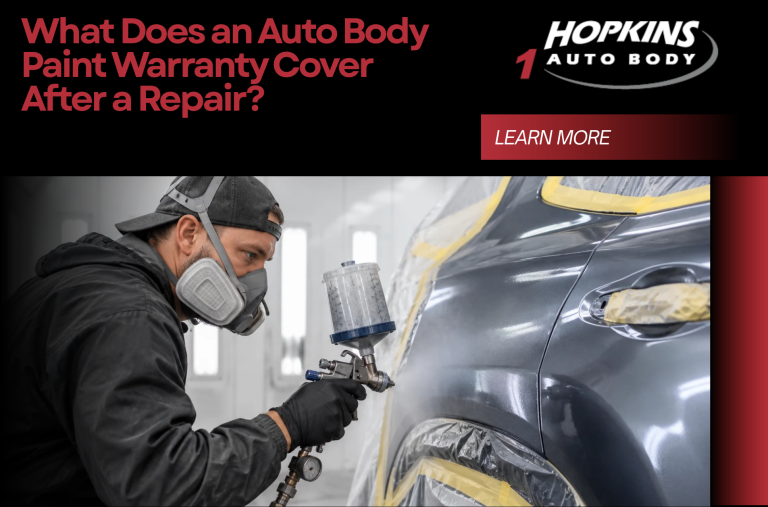
A professional refinish restores the affected surface and also provides a protective coating.
Still, many drivers wonder what happens if the new paint develops a problem months or years later.
Will the shop fix peeling paint?
What happens if the clearcoat starts to fail?
Does the warranty cover scratches or paint chips?
These questions matter because an auto body paint warranty generally addresses specific defects in repair materials or workmanship, not every type of paint damage that occurs after the vehicle leaves the shop.
The exact coverage always depends on the written warranty the repair facility provides.
For drivers in Minnetonka, St. Louis Park, Edina, and nearby Twin Cities communities, understanding this coverage can help when you review estimates and evaluate completed work.
Hopkins Auto Body 1 provides professional auto body repair and collision repair, and every repair includes a limited lifetime warranty on repair work and paint for as long as you own the vehicle.
This guide explains what paint warranties commonly cover, what they may exclude, how shops evaluate paint defects, and which questions to ask before approving a repair.
What Is an Auto Body Paint Warranty?
An auto body paint warranty is a written agreement that explains when a repair facility will correct certain problems with paintwork it performed.
The warranty may apply to materials, workmanship, or both.
In practical terms, it sets out the shop’s obligations if a qualifying defect develops after the repair.
A clear written warranty should identify:
- Covered paint defects
- The coverage period
- Which repairs it applies to
- Exclusions
- Claim procedures
- Any transfer restrictions
- Other relevant conditions
Does Every Auto Body Shop Offer the Same Paint Warranty?
No.
Auto body paint warranty terms vary from one business to another.
One shop may offer a limited lifetime warranty, while another may offer coverage for a fixed number of years.
Exclusions and claim procedures can also differ, so it makes sense to compare the written terms rather than the marketing language.
Is a Paint Warranty Automatically Included With Every Repair?
Not necessarily.
Some facilities include an auto body paint warranty on every repair, while others apply it only to certain types of work.
For that reason, drivers should confirm whether the completed repair comes with written paint warranty coverage and request a copy.
Why Should You Read the Written Warranty Terms?
Verbal descriptions rarely include every limitation or requirement.
The written warranty, on the other hand, contains the specific terms that govern coverage.
Reading it before you authorize repairs helps you understand:
- What the shop will correct
- How long coverage lasts
- What you need to do to keep it valid
- How to file a claim
What Paint Problems Does an Auto Body Paint Warranty Commonly Cover?
Coverage depends on the repair facility, but an auto body paint warranty commonly addresses certain paint defects.
Depending on the written terms, these can include:
- Paint peeling
- Paint flaking
- Paint blistering
- Premature coating separation
- Paint adhesion failure
- Clearcoat application defects
- Other defects caused by qualifying workmanship or materials
However, every instance of peeling or flaking does not automatically qualify.
Instead, the shop must evaluate the cause.
When the warranty includes materials-related defects, it can cover defective paint products, and when it includes workmanship, it can cover improper application.
New collision damage, by contrast, is generally separate from defects in the original repair.
Does an Auto Body Paint Warranty Cover Peeling Paint?
It can, when a covered defect caused the peeling.
Peeling happens when a coating separates from the surface or from another coating layer.
Potential causes include:
- Inadequate surface preparation
- Contamination
- Improper application
- Incompatible coating materials
- Adhesion problems
- Environmental or physical damage
Because peeling is not always a workmanship problem, the shop needs to determine the cause first.
It may qualify when the repair facility’s materials or workmanship caused it.
If paint begins peeling, contact the original repair facility, provide your repair documentation, and request an inspection.
Does a Paint Warranty Cover Clearcoat Failure?
Potentially, if a covered materials or application defect caused it.
Clearcoat is the outer protective layer in many modern automotive paint systems.
It protects the color layer and gives the finish its gloss.
Signs of clearcoat failure can include:
- Peeling
- Flaking
- Cloudiness
- Loss of gloss
- Blistering
- Coating separation
That said, every dull or faded surface does not qualify.
Normal aging, environmental exposure, and maintenance conditions can all affect coverage.
An inspection matters here because problems that look similar can have very different causes.
Does an Auto Body Paint Warranty Cover Blistering or Bubbling?
It depends on the cause and the written terms.
Blistering occurs when bubbles or raised areas form within or beneath a coating.
Possible causes include:
- Moisture contamination
- Surface contamination
- Improper preparation
- Coating application problems
- Corrosion beneath the coating
Some coating problems only become noticeable over time, so blistering can appear months after a repair.
Avoid popping or scraping paint bubbles yourself.
Altering the area can make it harder for a technician to evaluate the original condition.
Instead, photograph the concern and contact the repair facility to schedule an inspection.
Does a Paint Warranty Cover Color Mismatch After Collision Repair?
Potentially, when the warranty includes qualifying refinishing workmanship concerns.
Color matching is an important part of automotive refinishing, but several factors influence how a color appears:
- Original paint aging
- Sun exposure
- Metallic or pearl pigments
- Lighting conditions
- Viewing angle
- Application technique
- Blending methods
As a result, a slight difference does not always mean the repair was incorrect.
Certain colors simply look different under changing light.
If you notice a difference, look at the vehicle in natural daylight and under artificial light, then discuss the concern with the repair facility.
What Is Paint Blending, and How Does It Relate to Warranty Coverage?
Paint blending is a refinishing technique that transitions the repaired color into surrounding panels for a more consistent appearance.
Shops sometimes blend because original paint changes over time with age and environmental exposure.
Metallic, pearl, and certain multi-stage finishes often need extra attention.
However, every repair does not require blending.
A visible color difference also does not automatically qualify for warranty work.
Instead, the shop evaluates the repair against the written warranty and normal refinishing expectations.
For a closer look at this process, see why an adjacent panel may need paint blending after auto body repair.
Does an Auto Body Paint Warranty Cover Paint Chips and Scratches?
Generally, no.
An auto body paint warranty usually does not cover new physical damage from normal vehicle use.
Commonly excluded damage includes:
- Stone chips
- Parking lot scratches
- Road debris damage
- New collision damage
- Abrasion
- Vandalism
- Other external physical damage
Stone chips, for example, come from outside impacts rather than a defect in the original paint application.
Even so, a chip can lead to rust if it exposes bare metal.
So, have new paint damage evaluated promptly to decide whether touch-up or refinishing makes sense.
Does an Auto Body Paint Warranty Cover Rust or Corrosion?
Rust and corrosion coverage varies significantly from one auto body paint warranty to another.
Corrosion can develop after a repair when protective coatings are damaged, omitted, or compromised.
Some warranties address corrosion that results from qualifying repair defects.
Others exclude corrosion or handle it under separate terms.
Keep in mind that every rust spot does not mean the paint repair was defective.
New damage, environmental exposure, and previous repairs can also cause rust.
Therefore, ask whether the warranty specifically addresses corrosion in repaired or refinished areas.
Why Does Corrosion Protection Matter for Hopkins Drivers?
Minnesota winters expose vehicles to road salt, moisture, snow, and freeze-thaw cycles.
These conditions can speed up corrosion wherever protective barriers are compromised.
For Hopkins drivers, proper refinishing after a collision helps restore the coating system that protects the underlying metal.
However, an auto body paint warranty does not cover all winter-related damage, because environmental exclusions often apply.
What Paint Damage Is Usually Excluded From Warranty Coverage?
An auto body paint warranty commonly separates repair defects from damage caused by outside factors.
| Paint Concern | Typical Warranty Consideration |
|---|---|
| Peeling caused by defective repair workmanship | May be covered |
| Clearcoat separation caused by a qualifying application defect | May be covered |
| Blistering caused by covered material defects | May be covered |
| Significant color mismatch resulting from qualifying workmanship | Depends on warranty |
| Stone chips from road debris | Commonly excluded |
| Scratches from new physical damage | Commonly excluded |
| New collision damage | Commonly excluded |
| Bird droppings or chemical exposure | Often excluded |
| Normal paint aging or wear | Often excluded |
| Rust caused by new paint damage | Often excluded |
These are general examples, not Hopkins Auto Body 1’s specific warranty terms.
The applicable written warranty always determines actual coverage.
How Long Does an Auto Body Paint Warranty Last?
The length of an auto body paint warranty varies between repair facilities.
Not every auto body paint warranty is a lifetime warranty.
Some shops offer coverage for a set number of years, while others offer limited lifetime coverage.
To confirm the period, request the written warranty and review its effective dates and conditions.
What Does a Lifetime Paint Warranty Mean?
The meaning depends on the written terms.
Many lifetime warranties apply only while the original customer owns the vehicle.
Others include different conditions or limitations.
In addition, a lifetime warranty does not cover every paint problem forever, since exclusions and eligibility conditions still apply.
At Hopkins Auto Body 1, repairs include a limited lifetime warranty on repair work and paint for as long as you own the vehicle, subject to its written terms.
Can Warranty Coverage End When You Sell the Vehicle?
Yes, if the warranty is non-transferable.
Many limited lifetime versions of an auto body paint warranty tie coverage to the customer who authorized the repair.
If you plan to sell or trade in the vehicle, ask whether the coverage transfers to the next owner.
What Is the Difference Between a Paint Warranty and a Collision Repair Warranty?
An auto body paint warranty typically focuses on refinishing materials or workmanship.
A collision repair warranty may address a broader range of completed repair operations.
Depending on its terms, an auto body paint warranty might cover:
- Paint adhesion
- Application defects
- Clearcoat defects
- Other refinishing workmanship concerns
A collision repair warranty, on the other hand, might cover:
- Body repair workmanship
- Structural repair workmanship
- Refinishing
- Certain installed components
- Other qualifying repairs
Are Replacement Parts Covered Under the Paint Warranty?
Not necessarily.
Replacement parts often carry separate manufacturer or supplier warranties.
At Hopkins Auto Body 1, for example, parts are covered according to the applicable manufacturer warranty.
As a result, one repair can involve several warranty terms.
Review each one separately, because different repairs and components may have different coverage periods or exclusions.
To understand how parts choices affect a repair, see how OEM and alternative parts affect auto body repairs in Hopkins.
How Does Surface Preparation Affect Paint Durability?
Surface preparation is one of the most important stages of automotive refinishing.
Depending on the repair, technicians typically:
- Inspect the affected area.
- Remove damaged coatings as required.
- Clean the surface thoroughly.
- Complete any necessary body repairs.
- Apply appropriate preparation materials.
- Prepare the surface for the specified paint system.
Cleaning matters because contaminants interfere with coating adhesion.
Proper sanding also creates a suitable surface for the next layer.
Poor preparation can cause paint failure, which is one reason workmanship coverage exists.
Every vehicle does not need the same preparation, since materials, repair conditions, and coating systems vary.
The I-CAR Repairability Technical Support portal provides technical resources on collision repair procedures and refinishing considerations.
Why Do Primer, Basecoat, and Clearcoat Matter for Warranty Coverage?
Most modern automotive finishes use several coating layers, and each one has a job.
- Primer prepares the surface and supports adhesion, corrosion protection, or surface uniformity, depending on the product.
- Basecoat provides the vehicle’s color and visual effects.
- Clearcoat adds gloss and protects the color layer.
These products must be compatible with one another.
Otherwise, incompatible materials can weaken adhesion and coating performance.
Likewise, incorrect application can contribute to defects that may qualify under a workmanship warranty.
Why Is Paint Curing Important for Long-Term Durability?
Automotive coatings need the right curing or drying conditions to develop their intended properties.
Different paint products have different requirements for temperature and time.
When curing does not follow those specifications, the finish may lose durability.
For this reason, ask for the shop’s specific instructions about washing, waxing, and polishing a newly refinished surface after pickup.
How Does Paint Repair Help Protect a Vehicle in Hopkins, MN?
Paint does more than make a vehicle look good.
The coating system also shields the underlying surface from moisture and road treatment materials.
When protective coatings are damaged, exposed metal becomes more vulnerable to corrosion and deterioration.
Because winter road salt and moisture are common around Hopkins, restoring the coating system after a collision matters.
Proper refinishing restores protection to the repaired area according to the applicable repair requirements.
Does a Paint Warranty Cover Damage From Car Washes or Cleaning Products?
Usually not, although coverage depends on the cause and the warranty terms.
Harsh cleaning chemicals can damage paint.
Some automatic car washes can also leave scratches or swirl marks, and aggressive polishing can wear through clearcoat.
Warranties commonly exclude damage from external cleaning methods or improper maintenance.
So, follow the repair facility’s paint care instructions and use products designed for automotive finishes.
Can Previous Repairs Affect Paint Warranty Coverage?
Yes.
Earlier paintwork or body repairs can affect the condition of the surface a shop refinishes.
Older coatings or underlying repair materials may hide unknown problems, and those problems can affect a new repair.
A new repair facility also does not automatically warranty all previous paintwork on the vehicle.
Therefore, disclose earlier damage and ask exactly which surfaces and operations the new auto body paint warranty covers.
What Should You Do if a Paint Defect Appears After the Repair?
Contact the original repair facility and explain the concern.
Then follow these steps:
- Review the written warranty.
- Locate the original repair invoice.
- Photograph the affected area.
- Record when you first noticed the issue.
- Contact the repair facility.
- Schedule an inspection.
- Ask for an explanation of the findings.
- Follow the warranty claim process.
The shop needs to inspect the vehicle to determine the cause, and every reported concern will not necessarily qualify.
If the concern is covered, the remedy depends on the written warranty.
Should Another Shop Repaint the Area First?
Generally, no.
It is usually better to contact the original repair facility before you authorize additional work.
Otherwise, a second shop’s work can make it harder to evaluate the original repair and may affect your warranty.
The exception is when immediate action is necessary to prevent further damage.
Can an Auto Body Shop Deny a Paint Warranty Claim?
Yes, if the shop determines that the issue falls outside the warranty terms.
Common reasons include:
- New physical damage
- Environmental damage
- Normal wear
- Improper maintenance
- Previous unrelated repairs
- Expired coverage
- Non-transferable warranty conditions
A denial does not mean the paint problem is imaginary, because a real concern can still fall outside coverage.
You can always ask the shop to explain its findings.
Meanwhile, keep repair invoices, warranty terms, photographs, and written communications.
The Federal Trade Commission’s auto repair basics guide also explains important points about estimates, warranties, and repair documentation.
Does Insurance Cover Paint Problems After Collision Repair?
Insurance coverage and repair warranties are separate matters.
Insurance may cover qualifying accident-related damage under your policy.
An auto body paint warranty, by contrast, addresses qualifying defects in the completed refinishing work.
As a result, insurance does not automatically pay for warranty corrections.
If another accident damages the vehicle, you may need a new insurance claim, depending on the circumstances and your policy.
Hopkins Auto Body 1 also offers insurance claim assistance to help customers with documentation and communication about completed repairs.
Which Repair Documents Should You Keep for a Paint Warranty?
Good records make a future auto body paint warranty claim much easier.
Keep the following together:
- The final repair invoice
- The written warranty
- The original estimate and any supplements
- Photos taken at pickup
- Paint care instructions
- Any later correspondence with the shop
If you want to understand your estimate before work begins, review what a Hopkins driver should check in an auto body repair estimate.
What Should You Look for When Inspecting Fresh Paint at Pickup?
A final inspection helps you understand the completed repair before you drive away.
Check the following:
- Overall color consistency
- Gloss
- Paint texture
- Visible coating defects
- Panel edges
- Repaired area coverage
- Adjacent panel appearance
- Exterior trim condition
View the vehicle in natural light as well as artificial light, because each can reveal different aspects of the finish.
Metallic paint, for instance, can look different at certain angles.
Every small appearance difference does not indicate a defect, but you should ask the shop to explain anything that looks unusual before pickup.
What Questions Should Hopkins Drivers Ask About an Auto Body Paint Warranty?
Before approving a repair, consider asking:
- Is a written paint warranty included?
- How long does the coverage last?
- Does it cover materials, workmanship, or both?
- Is peeling paint covered?
- Does it cover clearcoat failure?
- How does the shop handle color matching concerns?
- Are rust or corrosion problems covered?
- Which types of damage are excluded?
- Can the warranty transfer to a new owner?
- What maintenance instructions should I follow?
- Which documents should I keep?
- How do I submit a warranty claim?
You do not need to understand every refinishing step yourself.
You should, however, understand what the written warranty promises before work begins.
Why Choose Hopkins Auto Body 1 for Auto Body Paint Repair?
Professional auto body repair involves more than making a damaged panel look presentable.
Surface preparation, repair methods, refinishing, corrosion protection, and final inspection all affect the quality of the finished work.
Hopkins Auto Body 1 has served the Hopkins community since 1962.
The shop holds I-CAR Gold shop certification, and its technicians hold I-CAR Platinum certifications.
Collision Center 1 also maintains OEM certifications across ten vehicle brands.
In addition, every repair includes a limited lifetime warranty on repair work and paint for as long as you own the vehicle, while parts are covered by the applicable manufacturer warranty.
Hopkins drivers can learn more on the Hopkins Auto Body 1 location page.
Frequently Asked Questions
What does an auto body paint warranty usually cover?
An auto body paint warranty may cover qualifying defects in refinishing materials or workmanship, such as peeling, flaking, blistering, or adhesion problems. The written terms determine actual coverage.
Does a paint warranty cover clearcoat peeling?
It may, when a covered materials or application defect caused the peeling. The repair facility must evaluate the cause first.
Does an auto body paint warranty cover scratches and rock chips?
Generally, no. New scratches, stone chips, and other physical damage are usually excluded because they are not defects in the original repair.
How long does an auto body paint warranty last?
Coverage periods vary by repair facility. Some warranties have fixed terms, while others offer limited lifetime coverage subject to specific conditions.
Does a paint warranty cover rust after collision repair?
It depends on the written warranty and the cause of the corrosion. Some warranties cover corrosion related to qualifying repair defects, while others exclude it.
Can a paint warranty cover a color mismatch?
Potentially. A significant color matching concern caused by qualifying refinishing workmanship may be covered, depending on the warranty terms.
What should I do if my repaired paint starts peeling?
Contact the original repair facility, provide your invoice and warranty information, and request an inspection before authorizing other corrective work.
Where can I get auto body paint repair in Hopkins?
Hopkins drivers can visit Hopkins Auto Body 1 at 10889 Excelsior Blvd, Hopkins, MN 55343 to discuss refinishing work and the shop’s written warranty terms.
Get Professional Auto Body Paint Repair in Hopkins
An auto body paint warranty can provide valuable protection when qualifying refinishing defects develop after a repair.
However, auto body paint warranty coverage is not the same at every collision repair facility.
Some warranties address:
- Peeling
- Blistering
- Clearcoat separation
- Other defects caused by covered materials or workmanship
Most also exclude stone chips, scratches, new collision damage, environmental exposure, and normal wear.
The best way to understand your coverage is to review the written warranty before authorizing repairs and to keep the documentation afterward.
Professional surface preparation, proper coating application, and appropriate curing also play a major role in how long a finish lasts.
So, instead of asking only “Does this shop offer a warranty?”, ask “What exactly does the written warranty cover, and for how long?”
Hopkins Auto Body 1 provides auto body repair, collision repair, paintless dent repair, and insurance claim assistance for Hopkins-area drivers, backed by a limited lifetime warranty on repair work and paint.
Hopkins Auto Body 1
10889 Excelsior Blvd Hopkins, MN 55343
This article provides general educational information. Specific warranty coverage depends on the written terms provided by the repair facility.