
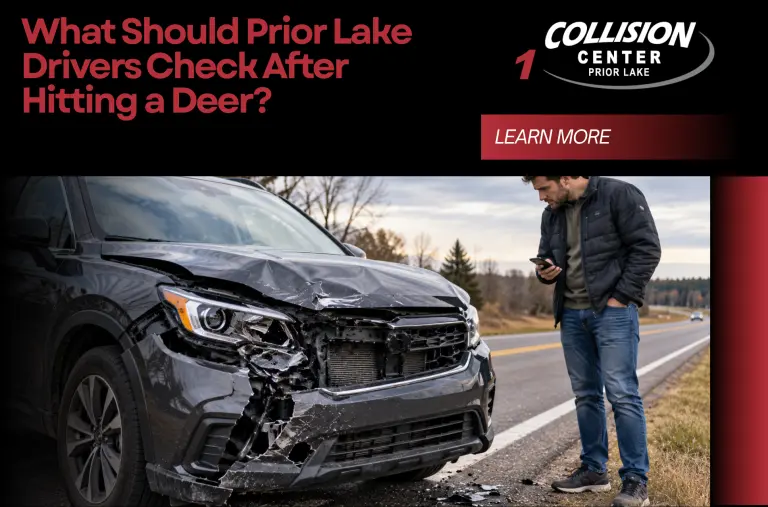
SUMMARY
- After hitting a deer, first determine whether you and your passengers are safe. Move the vehicle out of active traffic when it is safe and possible to do so.
- Do not approach an injured deer. Contact law enforcement or the appropriate local authority when necessary and follow their instructions.
- Before driving away, check for fluid leaks, damaged tires, loose body panels, broken lights, windshield damage, and warning messages.
- Deer collisions can cause more damage than the exterior suggests. Bumpers, grilles, headlights, hoods, fenders, cooling components, wiring, and sensor mounting points can all be affected.
- Check whether the hood still latches securely. A damaged hood or latch can create a serious problem if the hood opens while driving.
- Watch the instrument panel for warnings involving the engine, cooling system, airbags, cameras, radar, parking sensors, or other driver-assistance systems.
- If the vehicle begins overheating, leaking fluid, pulling, vibrating, or making unusual noises, stop driving when it is safe and arrange for professional assistance.
- Photograph the vehicle and accident scene when it is safe to do so. Keep those photos if you plan to file an insurance claim.
- A vehicle that still runs after hitting a deer may still have hidden collision damage. Have it professionally inspected before assuming the damage is only cosmetic.
- Prior Lake drivers can have deer-collision damage evaluated at Collision Center 1, 16111 Main Ave SE, Prior Lake, MN 55372.
You Hit a Deer Near Prior Lake. What Should You Do First?
A deer can appear in the road with very little warning.
After the impact, you may be looking at:
- Cracked bumper
- Broken grille
- Bent hood
- Damaged headlight
- Dented fender
- Broken windshield
Or the vehicle may look surprisingly normal.
Either way, do not start by asking:
“Can this damage be repaired?”
Start with:
“Is everyone safe, and is this vehicle safe to move?”
Collision damage can extend beyond what you can see from outside.
Step 1: Get Yourself and Your Vehicle Out of Immediate Danger
After the collision, focus on safety.
If the vehicle can be moved and it is safe to do so, get out of the active traffic lane.
Turn on your:
- Hazard lights
Be especially careful on:
- Dark rural roads
- Curves
- Hills
- Roads with narrow shoulders
- High-speed highways
Do not stand in an active traffic lane to inspect vehicle damage.
If anyone is injured or the crash creates an immediate roadway hazard, call 911.
Should You Approach the Deer?
No.
An injured deer can behave unpredictably.
Even if the animal appears unable to move, keep your distance.
Do not attempt to:
- Touch it
- Move it
- Load it into your vehicle
- Provide treatment
Contact law enforcement or the appropriate local authority when necessary and follow their instructions.
The Minnesota Department of Public Safety provides guidance for drivers involved in traffic crashes.
Step 2: Look for Fluid Leaks
Once you are safely away from moving traffic, look underneath the vehicle.
Do you see fresh fluid?
A deer impact to the front of a vehicle can potentially damage components associated with:
- Radiator
- Cooling system
- Air-conditioning system
- Windshield washer system
- Other front-end components
A fluid leak deserves attention before you continue driving.
Do not assume that a puddle is harmless simply because the engine still runs.
What if the Vehicle Is Leaking Coolant?
Continuing to drive a vehicle that has lost coolant can lead to overheating.
Watch the:
- Temperature gauge
- Temperature warning light
- Dashboard messages
If the engine begins overheating, stop driving as soon as it is safe.
Do not open a hot cooling system.
Pressurized hot coolant can cause serious burns.
A tow may be safer than attempting to drive the vehicle to a repair facility.
Step 3: Check the Front Bumper and Grille
The bumper and grille are often among the first areas affected during a deer collision.
Look for:
- Cracks
- Missing pieces
- Loose sections
- Parts hanging downward
- Grille damage
- Changed panel alignment
Do not pull damaged components away unless necessary for immediate safety.
A bumper that looks primarily cosmetic from outside can conceal additional damage behind it.
Professional collision repair begins by evaluating how far the impact actually traveled through the vehicle.
What Can Be Damaged Behind the Bumper?
Depending on the vehicle and impact, components behind or around the bumper may include:
- Energy absorber
- Reinforcement
- Mounting brackets
- Wiring
- Air ducts
- Sensors
- Radar mounting
- Cooling components
The exterior bumper cover can flex during an impact.
That means its appearance afterward does not necessarily show the complete extent of the damage.
Step 4: Check Whether the Hood Is Secure
Look carefully at the hood.
Does it appear:
- Raised on one side?
- Bent?
- Shifted backward?
- Uneven against the fenders?
Do not force a damaged hood open or closed.
A deer impact can potentially affect:
- Hood
- Hinges
- Latch
- Striker
- Surrounding mounting points
If the hood no longer latches securely, do not continue normal driving.
A hood opening unexpectedly while the vehicle is moving can block the driver’s view.
Can a Hood Look Closed but Still Have Latch Damage?
Yes.
The hood may appear approximately aligned while the latch or surrounding mounting area has been affected.
Look for changes such as:
- Hood sitting higher than before
- Uneven gaps
- Hood movement
- Difficulty latching
- Unusual resistance
If you are uncertain whether the hood is securely latched, have the vehicle evaluated rather than testing it at highway speed.
Step 5: Check the Headlights and Exterior Lighting
Deer collisions frequently affect the front corners of a vehicle.
Inspect:
- Headlights
- Turn signals
- Daytime running lights
- Fog lights, when equipped
- Marker lights
Look for:
- Cracked lenses
- Moisture
- Broken mounting
- Light pointing in an unusual direction
- Lamp no longer operating
A headlamp can still illuminate while its mounting tabs are broken.
That can allow the lamp assembly to move or point incorrectly.
Why Does Headlight Alignment Matter?
Headlights are designed to illuminate the roadway in a controlled pattern.
If an impact changes the lamp’s position, the beam may no longer be aimed as intended.
The repair should address:
- Lamp condition
- Mounting
- Alignment
rather than simply confirming that the bulb turns on.
Step 6: Inspect the Windshield
A deer can strike higher areas of the vehicle than many typical bumper-to-bumper collisions.
Inspect the windshield for:
- Chips
- Cracks
- Impact marks
- Loose glass
- Reduced visibility
Significant windshield damage can affect safe driving.
Collision Center 1 provides auto glass repair for collision-related glass concerns.
Some modern vehicles also use a forward-facing camera mounted near the windshield.
That means windshield replacement may involve more than installing new glass.
Does Windshield Replacement Always Require Camera Calibration?
No.
Calibration requirements depend on:
- Vehicle
- Installed equipment
- Camera system
- Glass replacement procedure
- Manufacturer requirements
If a forward-facing camera is involved, technicians should research the applicable OEM procedure.
Calibration should be performed when required rather than automatically assumed or skipped.
Step 7: Look at the Fenders and Wheel Openings
A deer impact can extend from the front bumper into the:
- Fender
- Wheel opening
- Wheel
- Tire
Look for:
- Fender touching the tire
- Loose wheel-well liner
- Tire damage
- Bent wheel
- Changed wheel position
If bodywork is rubbing against the tire, avoid driving the vehicle unnecessarily.
Tire contact can create additional damage as the wheel rotates.
What if the Steering Feels Different After Hitting a Deer?
Pay attention to:
- Pulling
- Vibration
- Steering wheel no longer centered
- New steering noises
- Vehicle feeling unstable
These symptoms can potentially involve:
- Wheel
- Tire
- Alignment
- Steering
- Suspension
Do not assume that an alignment alone will solve the problem.
A professional inspection should first determine whether any components were physically damaged.
Step 8: Check the Doors and Fender Gaps
A strong front-corner impact can sometimes affect how adjacent panels fit.
Look at the gap between:
- Fender and door
- Hood and fender
- Hood and grille
Open the front doors carefully.
Watch for:
- Door rubbing against fender
- Door requiring more force
- Unusual noises
- Changed panel gaps
These symptoms do not automatically mean the vehicle has major structural damage.
But they do indicate that something may have shifted and deserves further inspection.
Can Uneven Panel Gaps Mean Structural Damage?
They can, but they are not proof by themselves.
A changed gap could result from:
- Bent fender
- Damaged mounting bracket
- Hood movement
- Hinge movement
- Underlying structural movement
Professional measurement and inspection are needed to determine the cause.
I-CAR provides Repairability Technical Support resources that collision professionals can use when researching vehicle-specific repair procedures.
Step 9: Watch for Dashboard Warning Lights
After restarting the vehicle, look at the instrument panel.
Do not ignore a new:
- Check-engine light
- Temperature warning
- Airbag warning
- ABS warning
- Driver-assistance warning
- Camera warning
- Parking sensor warning
A warning message does not automatically tell you which component was damaged.
But it provides important information for the repair facility.
Photograph the message if possible.
That way you have a record even if the warning disappears later.
What if No Warning Lights Appear?
That is encouraging, but it does not prove that every affected component is undamaged.
Some physical damage may not immediately trigger a dashboard warning.
For example, an impact could potentially affect:
- Sensor mounting
- Bumper brackets
- Headlamp mounting
- Cooling components
- Body structure
without producing an obvious warning.
Physical inspection still matters.
Step 10: Consider Whether the Vehicle Has ADAS Sensors Near the Impact
Modern vehicles may contain cameras, radar, and other sensors around areas commonly damaged during deer collisions.
Depending on the vehicle, components can be located around the:
- Windshield
- Grille
- Front bumper
- Mirrors
These components can support Advanced Driver Assistance Systems, or ADAS.
The National Highway Traffic Safety Administration explains that driver-assistance technologies can include:
- Automatic emergency braking
- Forward collision warning
- Lane assistance
- Adaptive cruise control
- Blind-spot warning
Damage near a sensor does not automatically mean the sensor itself needs replacement.
But the affected area should be evaluated.
Does Every Deer Collision Require ADAS Calibration?
No.
Calibration requirements depend on:
- Vehicle
- Installed systems
- Impact location
- Components damaged
- Components removed
- Components replaced
- OEM procedures
A minor impact away from ADAS components may not require calibration.
A repair involving a camera, radar sensor, sensor bracket, windshield, or related component may have different requirements.
The repair facility should research the manufacturer procedure for the specific vehicle.
Step 11: Check for Loose Underbody Components
A deer can pass underneath a vehicle after the initial impact.
Look from a safe position for anything:
- Hanging
- Dragging
- Loose
Underbody damage can potentially involve:
- Splash shields
- Air deflectors
- Lower bumper components
- Exhaust-related components
- Other protective panels
Do not crawl underneath a vehicle parked along an active roadway.
A proper inspection may require the vehicle to be raised safely at a repair facility.
Why Can Underbody Damage Be Easy to Miss?
Drivers naturally inspect what they can see from standing beside the vehicle.
That usually means:
- Hood
- Bumper
- Grille
- Headlights
- Fender
The underside is much harder to see.
If the deer went underneath the vehicle, mention that during the estimate.
That information can help technicians know where additional inspection may be appropriate.
Step 12: Listen for New Noises
If the vehicle is safe enough to move, pay attention to sounds that did not exist before the collision.
Listen for:
- Scraping
- Rubbing
- Rattling
- Grinding
- Whistling
A new noise may come from:
- Loose bumper
- Wheel-well liner
- Underbody shield
- Damaged wheel or tire
- Misaligned body component
Do not simply turn up the radio and continue driving.
A new sound after an impact deserves investigation.
Step 13: Photograph the Damage
Once you are in a safe location, document the vehicle.
Take:
- Wide photos
- Front view
- Both front corners
- Close-ups
- Photos of broken components
- Photos of fluid on the ground
- Photos of warning messages
If it is safe and appropriate, document the accident scene as well.
The Minnesota Department of Commerce recommends taking photographs following an accident to document vehicle damage and the scene.
Keep the original photos.
They can be useful during the insurance and repair process.
Step 14: Decide Whether the Vehicle Should Be Driven or Towed
Do not make this decision based only on whether the engine starts.
Consider towing when you notice concerns such as:
- Fluid leak
- Overheating
- Tire damage
- Wheel damage
- Significant steering change
- Hood will not latch
- Loose body component
- Major windshield damage
- Important lights no longer function
- Severe warning messages
When uncertain, avoiding unnecessary driving is the safer choice.
A vehicle can start and move while still having collision damage that requires attention.
Is a Car Safe to Drive if the Damage Looks Minor?
Not always.
A cracked bumper cover might be largely cosmetic.
But similar-looking exterior damage could also hide:
- Broken reinforcement
- Damaged bracket
- Cooling-system damage
- Wiring damage
- Sensor mounting damage
The outside appearance alone cannot always answer whether the vehicle is safe to continue driving.
Step 15: Schedule a Professional Collision Damage Assessment
Once the immediate situation is under control, have the vehicle inspected.
During the estimate, explain:
- Where the deer struck
- Approximate driving speed, if known
- Whether the deer went underneath the vehicle
- Whether the vehicle began leaking
- Whether steering changed
- Whether warning lights appeared
- Whether the vehicle overheated
- Whether you heard new noises
Those details can help the estimator understand where additional inspection may be useful.
Prior Lake drivers can begin through the Collision Center 1 Prior Lake location.
What Should You Ask During the Deer-Damage Estimate?
Useful questions include:
- Is the damage limited to the exterior?
- Is anything damaged behind the bumper?
- Was the cooling system affected?
- Are the headlights mounted correctly?
- Is there damage around the wheel or suspension?
- Are ADAS sensors located in the damaged area?
- Does the manufacturer require scanning or calibration?
- Could additional damage appear after disassembly?
- Which parts can be repaired?
- Which parts require replacement?
You do not need collision repair expertise to ask useful questions.
The repair facility should be able to explain the repair plan in understandable terms.
Step 16: Understand Why Hidden Damage May Appear After Disassembly
The initial estimate may be based primarily on visible damage.
For example:
Initial inspection:
- Cracked bumper
- Broken grille
- Damaged headlamp
After disassembly:
- Broken bumper reinforcement
- Damaged brackets
- Sensor mounting damage
- Additional cooling-system damage
The additional accident-related work may be documented through a supplemental estimate.
That does not automatically mean the initial estimate was incorrect.
The additional damage may simply have been impossible to confirm from outside.
Why Can Deer Collisions Create So Much Hidden Damage?
A deer does not strike a vehicle like another bumper.
Its size and shape can spread the impact across multiple heights.
Damage may involve:
- Lower bumper
- Grille
- Headlights
- Hood
- Fender
- Windshield
At the same time, exterior components can conceal damage behind them.
That is why professional auto body repair involves evaluating the complete affected area rather than simply repairing the most visible dent.
Step 17: Ask About OEM Repair Procedures
OEM means Original Equipment Manufacturer.
Manufacturers publish repair information that can affect:
- Repair versus replacement
- Structural procedures
- Parts
- Welding or joining methods
- Scanning
- Calibration
- Corrosion protection
Collision Center 1 maintains multiple OEM certifications across its repair network.
The appropriate repair procedure can vary by:
- Make
- Model
- Year
- Damaged component
A procedure appropriate for one vehicle should not automatically be assumed appropriate for another.
Step 18: Contact Your Insurance Company if You Plan to File a Claim
If you plan to use insurance, report the collision according to your insurer’s process.
Have information such as:
- Accident date
- Location
- Photos
- Police or incident information, when applicable
- Repair facility information
available.
Collision Center 1 provides insurance claim assistance to help customers navigate communication associated with collision repairs.
The Minnesota Department of Commerce provides additional consumer information about auto insurance and claims.
Ask your insurer how the loss will be handled under your specific policy rather than assuming every deer collision claim is treated identically.
Does Insurance Cover Damage From Hitting a Deer?
Coverage depends on your policy and the circumstances of the loss.
Vehicle-animal collisions are commonly handled differently from collisions involving another vehicle, but the actual coverage available to you depends on the terms of your policy.
Ask your insurer:
- Which coverage applies?
- What is my deductible?
- What documentation is needed?
- Do you need photographs?
- What is the claim number?
Get answers based on your actual policy.
What if the Deer Only Dented the Hood or Fender?
The damage may be primarily cosmetic.
But first confirm that the impact did not also affect:
- Hood latch
- Headlamp
- Adjacent panel alignment
- Sensor mounting
- Components underneath
If the damage is limited to a suitable dent and the paint remains intact, paintless dent repair may sometimes be an option.
PDR suitability depends on:
- Dent size
- Dent shape
- Location
- Paint condition
- Panel material
- Accessibility
Not every deer dent is a PDR candidate.
What if the Deer Damaged the Windshield but Not the Bumper?
That can happen, particularly when the animal impacts higher portions of the vehicle.
Inspect:
- Windshield
- Roof edge
- Pillars
- Hood
- Mirrors
If the windshield is severely cracked or visibility is compromised, avoid unnecessary driving.
Also determine whether the vehicle has a camera mounted near the windshield and whether applicable manufacturer procedures require additional steps after glass replacement.
What if the Vehicle Starts Overheating Later?
Stop driving when it is safe.
A cooling-system problem may not become obvious immediately after the collision.
You may initially notice:
- Rising temperature gauge
- Temperature warning
- Steam
- Coolant smell
Do not continue driving an overheating vehicle simply because the repair facility is nearby.
Additional engine damage can occur.
Arrange appropriate assistance instead.
What if You Hit a Deer at Night?
Nighttime creates additional risks.
Your vehicle may have:
- Broken headlight
- Damaged marker light
- Reduced visibility
and other drivers may have difficulty seeing:
- Your vehicle
- Debris
- The animal
- You
Prioritize getting to a safe location.
Avoid standing near active lanes to take photographs or inspect cosmetic damage.
The detailed vehicle inspection can wait until you are somewhere safe.
Frequently Asked Questions
What should I check first after hitting a deer?
First make sure everyone is safe and move out of active traffic when possible. Then check for fluid leaks, tire or wheel damage, loose body parts, broken lights, hood-latch problems, windshield damage, and warning messages.
Can I drive my car after hitting a deer?
It depends on the damage. Avoid driving if the vehicle is leaking fluid, overheating, has tire or wheel damage, significant steering changes, an unsecured hood, loose components, or other conditions that may make continued driving unsafe.
Can a deer collision cause hidden damage?
Yes. Exterior bumper, grille, hood, and fender damage can conceal problems involving reinforcement, brackets, wiring, cooling components, sensor mounts, and other parts.
Should I approach the deer after the collision?
No. An injured animal can behave unpredictably. Keep your distance and contact law enforcement or the appropriate authority when necessary.
Can hitting a deer damage ADAS sensors?
Yes, depending on the impact location and vehicle. Cameras, radar, and other sensors can be located near the windshield, grille, bumper, and mirrors. The affected systems should be evaluated according to applicable OEM procedures.
Does every deer collision require ADAS calibration?
No. Calibration depends on the vehicle, equipment, damage, repair operations, and manufacturer procedures. It should be performed when required rather than automatically added to every repair.
Can deer damage be repaired with paintless dent repair?
Sometimes. A suitable hood or fender dent may qualify for PDR when the paint remains intact and the dent’s location, shape, material, and accessibility make the method appropriate.
Where can Prior Lake drivers have deer-collision damage inspected?
Prior Lake drivers can visit Collision Center 1 at 16111 Main Ave SE, Prior Lake, MN 55372 for professional collision damage assessment and repair.
Have Deer-Collision Damage Professionally Inspected in Prior Lake
After hitting a deer, the most important question is not how bad the vehicle looks.
It is whether the impact affected anything that could change:
- Safe vehicle operation
- Cooling
- Steering
- Lighting
- Visibility
- Body structure
- Electronic safety systems
Start by:
- Getting out of immediate danger
- Checking for leaks
- Inspecting the tires and wheels
- Checking the hood and lights
- Watching for dashboard warnings
- Photographing the damage
- Scheduling a professional inspection
Do not assume the damage is cosmetic simply because the vehicle still starts and drives.
A professional inspection can determine what was actually affected and whether the vehicle needs body repair, replacement parts, diagnostic procedures, or other collision-related work.
Prior Lake drivers can learn more about Collision Center 1’s auto body repair, collision repair, or visit the Prior Lake location to begin the repair process.
Collision Center 1 – Prior Lake
16111 Main Ave SE Prior Lake, MN 55372